
Contractor field guide · Free template
Define the work. Define done.
A strong scope marks the physical boundary, names each deliverable, assigns responsibilities, exposes assumptions and unknowns, and gives both parties an observable finish line.
The short answer
A task list says what to do. A scope says what result is owed.
“Install patio” names a category. A usable scope identifies the exact area, dimensions, demolition, base preparation, drainage intent, edge restraint, paver product and pattern, cuts, transitions, protection, cleanup, evidence, and acceptance checks.
The practical test is simple: Can another qualified person price it, perform it, recognize a change, and verify completion from the written record?
Five scope buckets
Sort every fact before it becomes an assumption.
Contractor deliverables
Tasks, quantities, materials, preparation, protection, testing, cleanup, documentation, and finish standard.
Outside the price and duty
Adjacent work, design, concealed repair, utility relocation, hazardous material, permits, restoration, or work by others.
Facts used to plan and price
Existing condition, access, dimensions, substrate, working hours, utilities, selections, and normal weather or availability.
Customer responsibilities
Access, decisions, utilities, cleared contents, products, approvals, information, payment, and coordination.
Conditions needing a decision
Define investigation, allowance or pricing basis, stop point, notice, safe condition, and change authorization.
Scope-builder sequence
Write from boundary to acceptance.
- 01
Anchor the location
Name the property, room, elevation, component, limits, dimensions, marked photos, drawings, and untouched adjacent areas.
- 02
Define each deliverable
Use action + object + quantity + material/standard + location + completed condition.
- 03
Include enabling work
State mobilization, access, demolition, preparation, protection, temporary work, testing, cleanup, disposal, and documentation.
- 04
Map interfaces
Assign permits, design, utilities, selections, owner products, other trades, inspections, shutdowns, and handoffs.
- 05
Expose uncertainty
List assumptions, exclusions, allowances, concealed conditions, stop points, and information still required.
- 06
Make done measurable
Define quantity, quality, tolerance, test, documentation, punch-list, and acceptance method for each major result.
Scope-builder worksheet
Contractor scope of work
Use this as a contract exhibit, estimate attachment, work-order source, or change-order scope. Identify the controlling document and revision.
Turn rough notes into approved scope with JobSign →- Project, purpose & controlling record
- [Parties, property, objective, contract/estimate/work order, revision, date, attachments]
- Location & physical boundary
- [Room/area/elevation/component, dimensions, stations, marked photos/drawings, adjacent area not included]
- Existing condition
- [Observed condition, measurements, photos, known damage, prior work, information relied upon]
- Deliverables & quantities
- [Numbered results using action + object + quantity + material/standard + location + completed condition]
- Materials, products & finish
- [Manufacturer/model, size, color, grade, quantity, pattern, sample, approved equivalent process, natural variation]
- Preparation & temporary work
- [Access, demolition, substrate, protection, containment, shoring, utility control, temporary cover/service]
- Installation / performance requirements
- [Required method, code/spec/manufacturer reference, slope/tolerance/output, sequencing and interfaces]
- Permits, inspections & submittals
- [Responsible party, permit, drawing, sample, product data, inspection point, approval deadline]
- Owner-provided / owner responsibilities
- [Access, cleared area, selections, product, utility, information, payment, occupants/pets, decision deadline]
- Assumptions
- [Specific conditions relied upon for price, schedule, method, availability, access, substrate, or utilities]
- Exclusions & work by others
- [Exact omitted work, adjacent restoration, design, hazardous material, concealed repair, utility/trade work]
- Unknowns, allowance & stop point
- [Unknown condition, included investigation, pricing allowance/basis, safe stopping condition, notice and approval]
- Protection, cleanup & disposition
- [Areas/items protected, daily/final cleanup, debris haul, salvage, removed material ownership]
- Schedule, constraints & dependencies
- [Start/finish or duration, work hours, sequence, lead time, weather, access, predecessor and successor tasks]
- Acceptance criteria & evidence
- [Measure/test/tolerance/visual standard, photo or report, inspection, demonstration, punch-list and reviewer]
- Change procedure
- [No expansion beyond boundary without the written approval required by agreement and law]
A scope is usually part of a broader agreement. Add every contract term, notice, price, payment, date, signature, and disclosure required for the project.
Vague to verifiable
Replace labels with observable results.
“Prep and paint bedroom”
Which surfaces, repairs, coats, product, sheen, color, protection, contents, trim, doors, closets, cleanup, and acceptance?
Walls, two coats, defined repairs
Protect listed items; fill nail holes and isolated dents up to stated limit; spot-prime; apply two coats specified eggshell to four walls; exclude ceiling, trim, doors, closet, water-damage repair, and furniture moving.
“Replace damaged deck boards”
How many, which boards, what material, fasteners, joist condition, finish, disposal, and hidden-damage boundary?
Eight marked boards
Replace eight photo-marked 5/4 boards with specified grade and fasteners; cut flush at listed boundary; dispose of removed boards; joist repair and finish coating excluded pending discovery.
Completed example
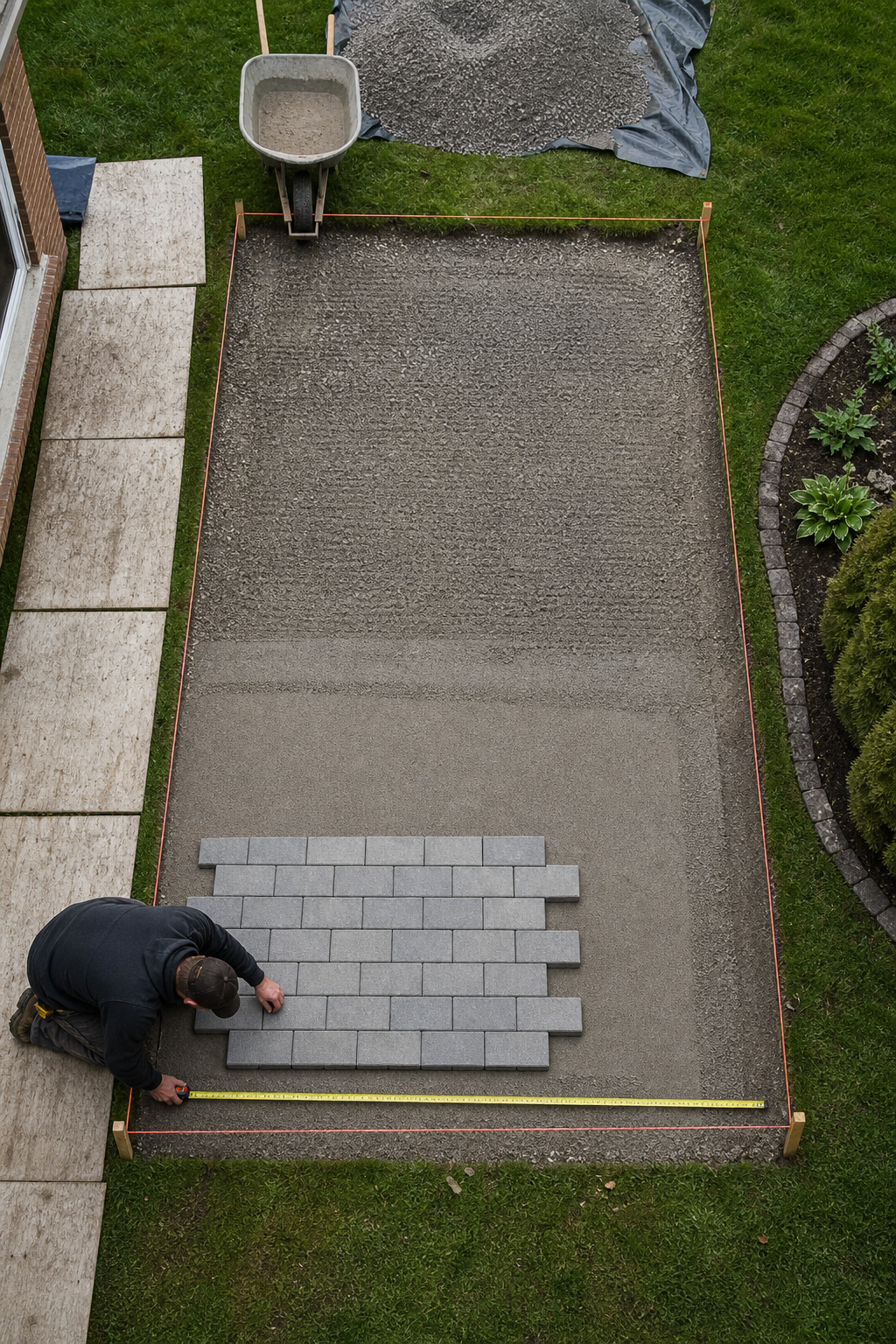
10-by-14-foot paver patio
140-square-foot marked rectangle
Excavate within staked boundary, place compacted aggregate and bedding layers, install specified gray pavers in running bond, cut edges, install restraint, joint sand, compact, and clean.
Garden and utility changes
Existing curved bed, irrigation relocation, electrical, steps, wall, lighting, drainage system, and repair beyond the marked rectangle are not included.
Normal soil and access
Pricing assumes equipment access through side gate, no buried obstruction in marked excavation, and existing grade can support drainage away from the house.
Boundary, pattern, slope, stability
Verify dimensions, approved pattern and border, consistent joints, stable units, clean transitions, documented drainage direction, and final site cleanup.
Acceptance matrix
Give every major deliverable a test.
How much?
Count, dimensions, area, volume, length, capacity, or defined allowance.
What standard?
Product, sample, manufacturer instruction, code, tolerance, finish, or performance level.
What proves it?
Photo, reading, receipt, test, inspection, report, serial, checklist, or demonstration.
Who accepts it?
Named customer, designer, inspector, contractor lead, or authorized representative and deadline.
Research basis
Specific inputs matter, but measurable outcomes define done.
California CSLB advises describing materials and work in detail, including size, color, quantity, manufacturer/model, cleanup, permits, and timing. FAR performance-work guidance uses measurable standards such as quality, timeliness, and quantity and favors required results that can be assessed. DOE’s project lexicon describes a scope statement through deliverables, assumptions, constraints, and required work, and a statement of work through description, location, period, schedule, standards, and special requirements.
Federal acquisition rules do not govern an ordinary residential project; they provide useful drafting concepts. The contract and local law determine required form and content.
- California CSLB: detailed work and materials ↗
- FAR 37.6: measurable performance standards ↗
- DOE: Scope and SOW definitions ↗
- GSA: deliverable inspection and acceptance ↗
This operational guide is not a universal contract form. Adapt scope, specifications, permits, codes, notices, price, payment, schedule, risks, and signatures to the actual job.
Contractor scope of work questions
How detailed should a scope be?
Detailed enough to price, plan, perform, identify a change, and verify completion without relying on unstated expectations.
Are exclusions enough to control scope?
No. Define inclusions, responsibilities, assumptions, unknowns, acceptance criteria, and the change process as well.
Should the scope dictate methods?
Specify methods when code, design, compatibility, sequence, warranty, safety, or agreed quality requires them. Otherwise, emphasize the required result and standard.
What happens when an assumption is wrong?
Document the condition, stop at the stated boundary, protect the site, assess the effect, and obtain the required change authorization.
From rough note to clear scope
Put the boundary and finish line beside the approval.
Use JobSign to structure inclusions, exclusions, assumptions, responsibilities, unknowns, and acceptance before work moves.
Get JobSign →