
Trade guide · Roofing
Expose the condition. Measure it. Approve before covering it.
Use four filled examples for deck replacement, flashing and ventilation, owner upgrades, and permit or inspection findings, with weather and unit-price controls built in.
The field rule
Preprice the unknown before the roof is open.
Roofing contracts can define how concealed deck, flashing, and ventilation conditions will be measured and priced even when the final quantity is unknown. A signed unit price plus estimate, notice threshold, NTE ceiling, photo method, and stop rule is more useful than “wood extra as needed.”
Keep customer authorization separate from the employer’s fall-protection and weather-safety decisions. OSHA emphasizes fall protection in roofing work; manufacturer instructions and the adopted jurisdiction determine project-specific deck, underlayment, flashing, ventilation, fastening, permit, and inspection requirements.
Before tear-off
Agree on six controls while the roof is still closed.
- 01
Baseline
Identify roof areas, layers assumed, deck type/thickness, included repair allowance, products, flashing, ventilation, disposal, permits, and exclusions.
- 02
Measurement
Choose sheet, square foot, linear foot, unit, layer, or labor-hour rules; define rounding, partial sheets, waste, and installed versus removed quantity.
- 03
Evidence
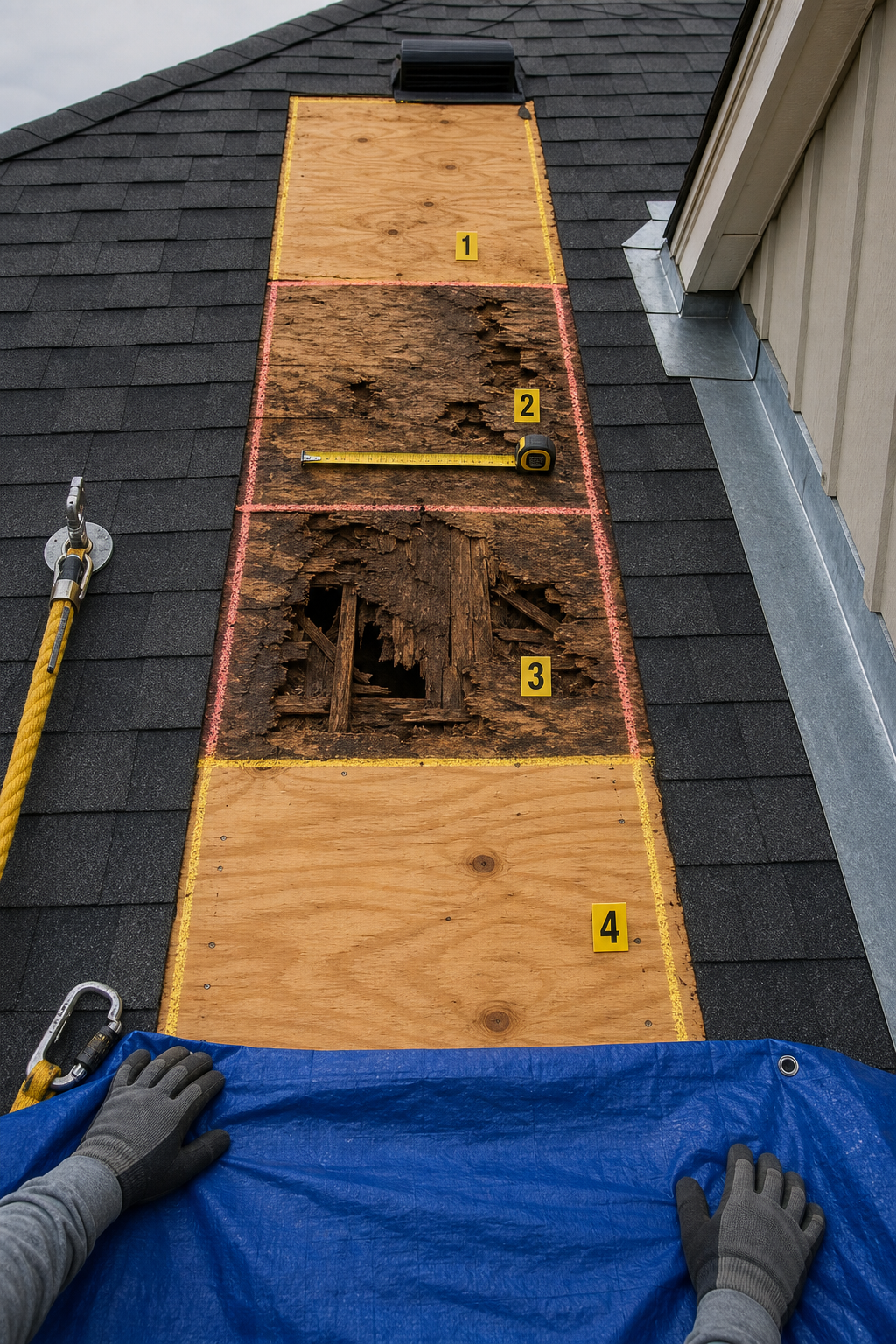
Require overview, scale, marked boundary, close-up, quantity register, and before-cover photo linked to each discovery.
- 04
Money
State unit price, included allowance/credit, estimate, notice percentage, maximum quantity or NTE, markup/tax basis, and revised total.
- 05
Weather and schedule
Define temporary dry-in, exposed-area limit, forecast decision, suspension, added days, remobilization, material protection, and customer response deadline.
- 06
Stop and authority
Pause for structural, widespread, hazardous, permit, design, product, utility, or materially different conditions and verify signer authority.
Four filled examples
Scope language for the moment tear-off changes the job.
Deteriorated roof decking
Baseline: existing [deck type/thickness] suitable for specified roof system; 2 sheets included. Discovery: marked zones D-01 onward are deteriorated or unsuitable under verified project criteria after tear-off. Authorize: remove and replace full or partial areas measured as installed 4-by-8-sheet equivalents at $165 each, including listed sheathing, ordinary fastening, cutting, handling, and disposal. First 2 sheets credited; notify at 10 total; stop before 20 without new approval. Attach overview, scale, sheet map, and before-cover photos. Excludes rafters/trusses, widespread structural repair, insulation/interior finishes, hazardous material, engineering, and cause remediation. Each 8 sheets adds approximately one working day, weather permitting.
Sidewall and chimney flashing revision
Original: reuse serviceable flashing where compatible and include standard listed roof-to-wall details. Finding: existing sidewall/chimney conditions at F-01/F-02 differ from proposal assumptions and project-specific manufacturer/authority requirements documented in attachments. Change: remove affected roofing, install the listed new step/counter/apron flashing scope and compatible underlayment, coordinate masonry or siding interface exactly as stated, and restore roofing. Excludes: chimney rebuild, masonry waterproofing, siding/stucco/paint, concealed framing, interior leak damage, and guarantee that prior leakage has only one source. Price $2,380; two added working days; permit/inspection result remains authority-controlled.
Material and ventilation selection change
Baseline: [original shingle/product/color], listed underlayment and existing ventilation scope. Customer change: select [revised product/color/system] and approved ventilation revision V-02 before order cutoff. Includes documented material delta, accessories, changed labor, freight, supplier restocking/credit, revised layout, and manufacturer instructions applicable to selected products. Excludes: deck/structure changes, intake work not listed, electrical fan work, interior alterations, warranty eligibility guarantees, color match beyond approved samples, and further selection changes. Adds $3,950 and [___] days based on confirmed availability; customer approval by [date/time] is required to hold delivery and dry-in schedule.
Permit or inspection-driven additional work
Trigger: [named authority] record [ID/date] identifies a project-specific correction affecting the permitted roof scope. Authorize: exact listed item, revised drawing/submittal if included, materials and labor at stated rates, fee basis, photo record, and reinspection coordination within $4,800 NTE. Notify at 70%; stop for design/engineering, structural alteration, unrelated existing conditions, unavailable product, broader roof area, utility work, or finish restoration. Weather protection of the currently opened area is included as described; added exposure or remobilization caused by delayed customer/authority decision is separately priced. No generic promise to “bring the whole roof to code,” secure insurance payment, or obtain authority acceptance.
Reusable field sheet
Roofing concealed-condition change
Link every measured quantity to a roof map and before-cover photo.
Create a roofing change order with JobSign →- Original baseline
- [Roof area/layers/deck assumption, included allowance, products, flashing, ventilation, permit, disposal, restoration]
- Discovery or request
- [Date, tear-off stage, exact location, observed condition/customer selection, verified criterion, photo/map/authority IDs]
- Changed work
- [Removal, deck, underlayment, flashing, ventilation, roofing, accessories, protection, disposal, inspection, deleted work/credit]
- Measurement rule
- [Sheet/sq ft/linear ft/unit/hour, partials/rounding, waste, installed quantity, who measures, register and photo method]
- Pricing controls
- [Unit/rates/fixed price, included allowance, estimate, notice threshold, max quantity/NTE, tax/markup, payment]
- Weather and schedule
- [Exposed-area limit, temporary dry-in, forecast/suspension, decision deadline, added days, remobilization, material protection]
- Stop conditions
- [Structural/widespread damage, hazardous material, design/permit, unavailable product, different assembly, utility, unsafe weather]
- Exclusions
- [Rafters/trusses, engineering, masonry/siding/interior finish, mold/remediation, leak-source guarantee, insurer/warranty promises]
- Revised total and approval
- [Original + prior changes + estimate/authorized ceiling; final measured reconciliation; signatures, timestamps, completed copy]
Adapt to the actual roof system, manufacturer instructions, adopted code, permit, safety plan, weather, license, contract, insurer process, and jurisdiction. This form does not determine structural adequacy, warranty eligibility, insurance coverage, or code compliance.
Research basis
Sound deck, project details, and worker safety need separate verification.
Owens Corning’s underlayment instructions state that roof decks should be structurally sound and meet deck-manufacturer and local-code requirements. Its installation library and GAF shingle instructions illustrate why selected roofing, underlayment, flashing, and ventilation details must be checked against the exact product and assembly.
OSHA identifies falls as a leading hazard in residential construction and says fall protection is critical during roofing and weatherproofing. A customer change order can document schedule and roof-protection consequences, but it does not replace the employer’s site-specific safety compliance.
- Owens Corning: deck and underlayment instructions ↗
- Owens Corning: roofing installation library ↗
- GAF: shingle, flashing, and ventilation instructions ↗
- OSHA: residential roofing fall-protection guidance ↗
This guide is documentation guidance, not roofing, structural, safety, code, warranty, insurance, or legal advice. Verify all project requirements with qualified people and current authoritative sources.
Roofing change order questions
How should decking replacement be approved?
Use a defined unit, unit price, measurement and photo method, allowance, estimate, notice threshold, ceiling, schedule effect, and stop point.
Should flashing and ventilation be separate?
Yes when locations, products, requirements, prices, access, or finish boundaries differ. Cite the verified project reason.
What about weather while approval is pending?
State temporary protection, exposure limit, forecast suspension, customer deadline, added time, remobilization, and limitations.
Does approval guarantee warranty or insurance?
No. Keep product requirements, warranty source/registration, and insurer decisions separate; do not promise eligibility or claim payment.
Measure before cover
Turn concealed roof conditions into a signed quantity and price.
JobSign helps roofers attach evidence, define unit pricing and limits, collect approval, and share the completed PDF.
Explore change order approvals →