
Contractor field guide · Free template
The wall is open. Now get the change in writing.
A hidden condition changes the conversation fast. Use this field-ready template to record what you found, show what it changes, and get the customer’s decision before the added work begins.
The short answer
A hidden condition change order records a discovery that changes the agreed work.
It should state what was uncovered, where and when it was found, how it differs from the original scope or assumptions, what work is affected, and what correction is proposed. It should also show the added or reduced price, any schedule effect, and the customer’s dated decision.
A discovery does not automatically prove who must pay. Responsibility can depend on the contract, the written scope, what was reasonably visible before pricing, inspection obligations, project facts, and state law. The document creates a clear decision record; it does not replace that analysis.
The field workflow
Stop the affected work. Keep the decision moving.
The goal is not to stop the entire job. It is to preserve the condition, explain the boundary, and give the customer a concrete choice.
- 01
Make it safe
Address any immediate safety or property-protection need. Pause only the work affected by the discovery when practical.
- 02
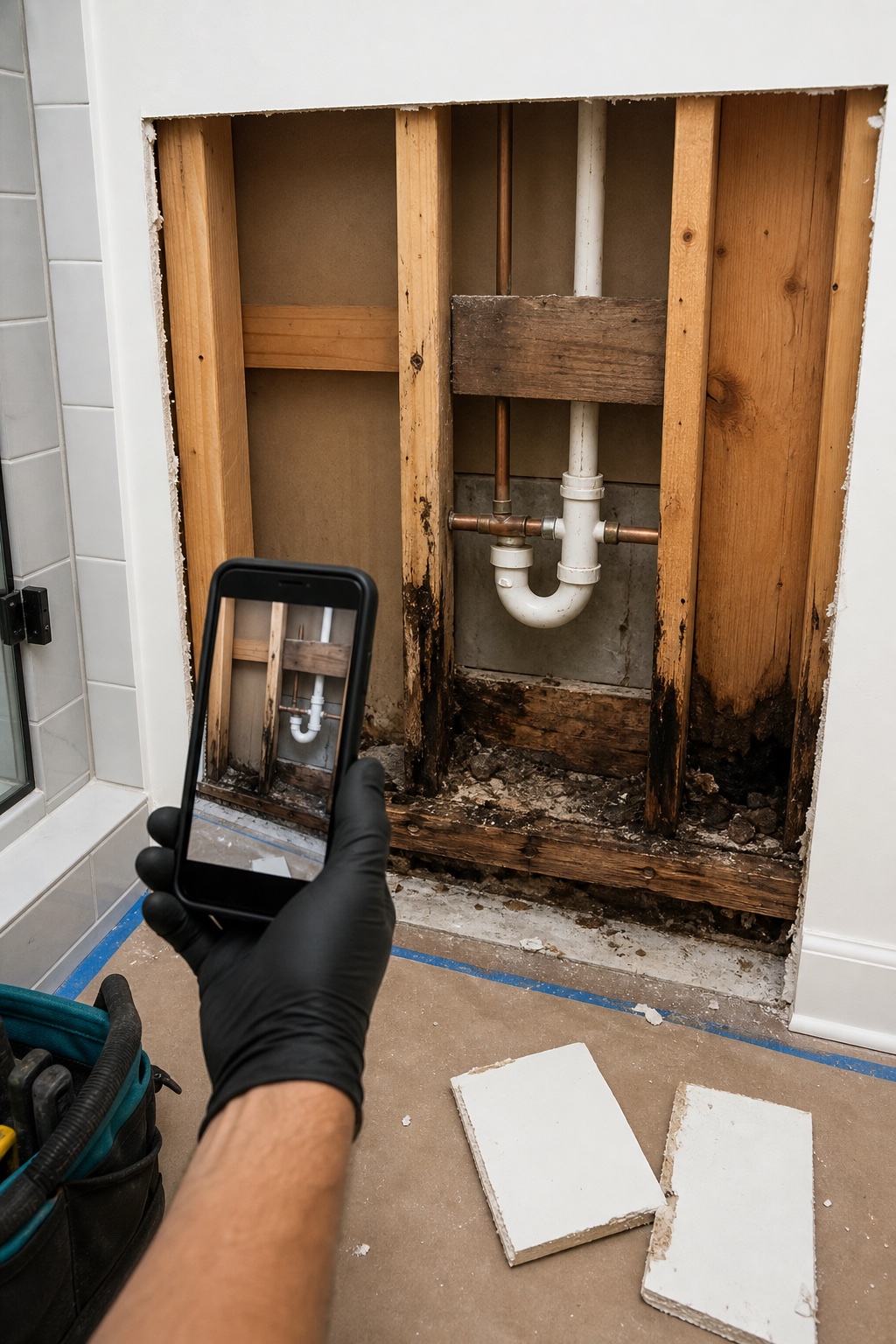
Document before disturbing
Take a wide photo for location, a context photo, and close details. Record the date, exact area, and factual observations.
- 03
Connect it to the scope
Quote or reference what the approved scope included, excluded, or assumed. Avoid blame and unsupported conclusions.
- 04
Price the next decision
Offer a fixed price, unit price, time-and-materials basis, or not-to-exceed cap. Include schedule and payment effects.
- 05
Get the written decision
Record who approved or declined, the date, and what happens next. Send the customer a copy and retain it with the job.
Copyable template
Hidden condition change order
Replace the bracketed prompts. Keep the observations factual and tie every price or schedule change to the proposed added work.
Create and sign it with JobSign- Project
- [Customer, address, and original agreement or estimate date]
- Discovery
- [Date, time, exact location, and stage of work]
- Observed condition
- [Describe only what was observed. Include dimensions or quantities when available.]
- Original scope boundary
- [State what the approved scope included, excluded, or assumed.]
- Supporting record
- [List photo numbers, test results, inspector notes, or specialist recommendations.]
- Affected work status
- [State what is paused, protected, or able to continue.]
- Proposed added work
- [Describe the correction, quantities, materials, access, cleanup, and exclusions.]
- Price change
- [Add/credit $___, unit price, T&M rates, or NTE $___; state what is included.]
- Schedule & payment effect
- [Added days, lead-time dependency, revised milestone, and payment timing.]
- Decision
- [Approved / declined / alternative requested. No affected added work starts until required approval is received.]
Adapt this operational template to your contract, trade, project, and local requirements. It is not legal advice.
Completed example
Bathroom subfloor damage discovered after removal
This example separates the visible discovery from the proposed correction and uses a not-to-exceed cap until the final repair quantity is known.
After removing the toilet and finish flooring on July 10, the crew found deteriorated subfloor around the toilet flange. The visibly affected area is approximately 24 by 32 inches. Three photos are attached.
The accepted estimate includes removal and replacement of finish flooring. It excludes repair of concealed subfloor damage discovered after demolition.
Remove affected subfloor to sound material, install matching-thickness exterior-grade plywood, coordinate flange height, dispose of debris, and prepare the repaired area for the approved flooring.
Time and materials, not to exceed $750 without further written approval. Includes labor, plywood, fasteners, and disposal. May add one working day.
Approve added work up to $750 / Request another option / Decline and leave affected flooring work paused
Use the same pattern
Different trade. Same decision record.
Damaged decking after tear-off
Use an approved per-sheet unit price with photos and a quantity record.
Existing wiring condition after access
Document the observation and qualified recommendation without making unsupported code claims.
Failed valve discovered during fixture work
Separate the original fixture scope from shutoff replacement and access restoration.
Substrate not ready after removal
Record flatness, moisture, or damage findings and price the selected preparation method.
Write what you know
Facts first. Conclusions only when supported.
“After removing the baseboard, the crew observed darkened and softened wood at the lower right corner. The affected area visible today is approximately 18 inches wide.”
“The homeowner’s leak caused major structural damage and the whole wall must be rebuilt.”
Research & limitations
Why written approval matters
California’s Contractors State License Board says that, for covered California home-improvement work, changes to contract price or scope must be handled through a written change order signed by the customer and contractor before the change. Its contractor guide identifies scope, cost, and progress-payment schedule effects as core change-order information.
Oregon’s Construction Contractors Board publishes a sample that identifies the original contract, changed work, revised completion date, price change, and acceptance. These are useful examples of clear documentation, but they are not a universal national form.
- California CSLB: What is a Contract?
- California CSLB: Contracting for Success
- Oregon CCB: Sample Change Order
This guide provides general operational information for contractors. It is not legal advice and does not determine whether a condition is compensable, who is responsible, or whether a particular form satisfies your contract or local law.
Hidden condition questions
What is a hidden condition change order?
It is a written record used when work reveals a concealed condition that changes the agreed scope, price, schedule, or method. It identifies the discovery, connects it to the original scope, describes the proposed added work, and records the customer’s decision.
Does finding a hidden condition automatically mean the customer must pay more?
No. Responsibility depends on the original scope, what was reasonably observable, inspection obligations, the contract, project facts, and applicable law. Document the condition and review the governing agreement before presenting it as added work.
Can photos replace a written change order?
Photos can show what was visible at a particular time, but they usually do not state the proposed correction, price, schedule effect, or customer decision. Use photos as support for the written approval record.
Should the contractor continue before approval?
For ordinary added work, the safer operational practice is to make the area safe, pause the affected work, and obtain the approval required by the contract and local rules. Emergencies and safety duties may require a different response.
From discovery to decision
Describe what you found. Send the approval. Keep the signed PDF.
JobSign turns a field note and photos into a clear customer approval while the condition is still in front of you.