
Trade guide · Plumbing and repair
Authorize the next safe step, not an unknown repair.
Use six filled examples to separate the reported symptom, diagnostic access, discovered condition, shutoff, authorized repair, testing, price limit, and finish-restoration boundary.
The operating rule
A symptom tells you where to start, not what to sell.
“Water under the sink,” “ceiling stain,” and “slow drain” are observations. The source may be a fitting, fixture, supply, drain, seal, appliance, condensation, exterior entry, or another system. EPA WaterSense likewise notes that leaks can have varied causes and that visual, meter, moisture, or flow evidence helps identify irregular use.
A plumbing authorization should define the next permitted step and its stop point. If diagnosis reveals different work, preserve the finding with photos, measurements, test results, and affected-system details, then obtain the customer decision required by the agreement and applicable law before expanding scope.
Four authorization layers
Do not collapse diagnosis and repair into one vague line.
- 01
Observed condition
Record who reported what, where and when; visible moisture, flow, sound, odor, pressure, meter, fixture, damage, prior attempts, and immediate protection already taken.
- 02
Diagnostic permission
Name non-destructive tests, equipment, fixture removal, shutoff, drain access, opening location and maximum size, estimated price, uncertainty, and diagnostic stop point.
- 03
Discovered condition
Identify the confirmed or still-unconfirmed source, affected component, material/size, evidence, code or manufacturer information actually verified, options, and consequence of deferral.
- 04
Repair authorization and closeout
Define exact repair, materials, price/limit, permits/inspection where applicable, outage, protection, tests, restoration, exclusions, warranty terms, schedule, signatures, and completed copy.
Six filled examples
Realistic boundaries for common plumbing calls.
Ceiling stain with unknown source
Observed: new 18-by-10-inch stain below upstairs bath; moisture reading and photos attached, no active dripping at arrival. Authorized: inspect accessible fixtures and connections, perform non-destructive fixture tests, monitor meter/flow where appropriate, and make one owner-approved exploratory opening no larger than 12 by 12 inches at marked location A-01 if needed. Stop: diagnose and protect only. Pipe/fixture repair, mold or hazardous-material work, cabinet/tile removal, drying, and finish restoration require separate scope. Notify customer before opening and at 75% of limit.
Failed fixture shutoff discovered before faucet replacement
Original: replace kitchen faucet using operable hot/cold stops. Discovery: cold stop does not isolate and hot stop leaks at stem during prework test; photos V-01/V-02. Change: coordinate customer-approved building/main shutoff, drain and protect work area, replace two listed stops and compatible connectors, restore water, inspect visible joints under operating pressure, then perform faucet scope. Excludes: failed main/building valve, inaccessible piping, wall/cabinet modification, and damage caused by concealed deterioration. Customer will provide access and notify affected occupants as assigned.
Drain clearing with a defined diagnostic stop
Observed: kitchen sink drains slowly and backs up during sustained flow; no other fixture symptom reported. Authorized: protect cabinet, inspect accessible trap and branch entry, remove/reinstall accessible trap as suitable, and attempt mechanical cable clearing from listed access for up to [___] minutes. Stop and report if: cable cannot pass, repeated obstruction suggests damaged/misaligned piping, another fixture is affected, sewage release exceeds containment, or additional access is required. Camera inspection, hydro-jetting, pipe repair, roof access, excavation, cleanup beyond the work area, and restoration are excluded unless separately approved.
Owner faucet with missing or incompatible parts
Baseline: install owner-supplied [manufacturer/model] in existing three-hole sink using existing serviceable stops; labor $[___]. At inspection: fixture is [sealed/opened], included parts listed on photo F-01; required [deck plate/adapter/connectors] are missing or existing connections differ from stated assumption. Options: customer supplies correct parts by [date], contractor supplies listed parts for $[___], or customer approves adaptation labor/material under $[___] NTE. Manufacturer product warranty remains with customer/manufacturer; contractor workmanship scope, testing, returns, finish damage, and schedule responsibility are stated separately.
Limited wall access and branch-line repair
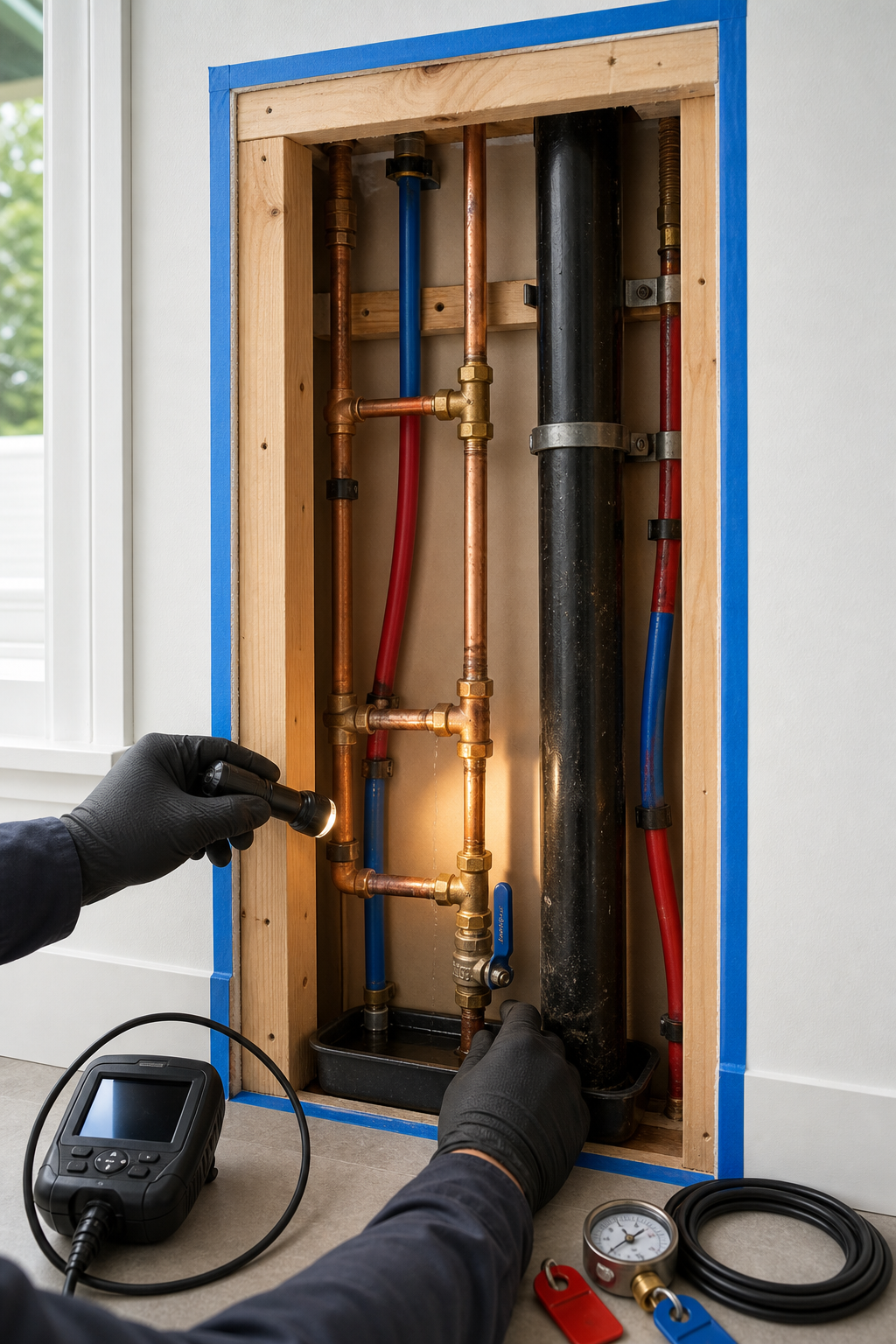
Finding: diagnostic work confirms active leak at the marked branch fitting inside wall bay B-02. Authorized: shut off listed supply, protect area, enlarge existing opening only to maximum 18 by 24 inches within taped boundary, remove affected fitting and limited adjacent pipe, install compatible listed repair materials, restore supply, and perform project-appropriate visible leak/operation checks. Restoration: temporary secure cover included; insulation, drywall patch, texture, paint, tile, cabinet, waterproofing, drying, and concealed-damage remediation excluded. Any framing, electrical, hazardous material, or broader pipe deterioration stops work for review.
Field condition differs from planned fixture connection
Original: replace fixture at existing rough-in without relocating services. Discovery: actual vent, trap, drain, supply, clearance, support, or approved-product condition differs from the documented assumption. Next step: contractor will identify the exact adopted jurisdiction, applicable permit/inspection path, verified requirement or official direction, repair options, affected finishes, price, and schedule before proceeding. Not authorized: a generic “bring to code” allowance, concealed-system reconstruction, structural alteration, or work outside licensed/permitted scope. Approval references the specific finding and source, not an unsupported compliance guarantee.
Customer decision points
Put the irreversible choices in plain view.
Who can authorize shutoff?
Name system, area, duration estimate, notice responsibility, affected occupants/equipment, drain-down, restart, and failed-valve contingency.
How much may be opened?
Mark location and maximum size; define removal, salvage, temporary cover, dust/water protection, contents movement, and finish restoration.
What ends this authorization?
Use time, dollars, access boundary, test result, equipment limit, unsafe condition, or materially different finding as an explicit stop.
What proves the authorized step is complete?
Record installed components, photos, observed operation or project-specific test, remaining conditions, customer instructions, and excluded restoration.
Reusable field sheet
Staged plumbing authorization
Use one revision for diagnosis and a new revision or linked change when the customer approves the discovered repair.
Create a repair approval with JobSign →- Project and authority
- [Customer, property/unit, contractor, requester, owner/manager, authorized signer, original agreement/work order]
- Reported symptom
- [Who observed what, location, first noticed, frequency, affected fixtures, prior work, immediate protection]
- Arrival evidence
- [Visible water/damage, moisture/flow/meter/pressure observation, odor/sound, photos, no-source-yet statement]
- Authorized diagnostic steps
- [Inspection, fixture tests, meter/flow observation, camera/cable, removal, shutoff, access opening, maximum time/cost]
- Access and restoration
- [Marked location/size, finish/material, protection, salvage, temporary cover, patch/texture/paint/tile/cabinet responsibility]
- Shutoff plan
- [Local/main/building system, duration estimate, notice/permission, affected occupants/equipment, failed-valve contingency, restart]
- Stop conditions
- [Dollar/time threshold, access boundary, different system, unsafe/regulated condition, permit, unavailable part, broader failure]
- Discovered condition
- [Confirmed/still uncertain source, component/material/size/location, cause if supportable, evidence, options, defer consequence]
- Authorized repair
- [Exact removal, installation, materials/model, support/access, permit/inspection, testing, cleanup, customer responsibilities]
- Price and schedule
- [Dispatch/diagnostic/fixed/unit/T&M/NTE, rates, materials, equipment, tax/markup, deposit/payment, outage, added days]
- Exclusions
- [Additional leaks, failed shutoffs, hazardous materials, mold/drying, electrical/structural work, broader piping, finish restoration]
- Closeout and approval
- [Photos, test/observed result, parts, remaining conditions, instructions, warranty scope, signatures/timestamps, completed copy]
Use licensed and qualified people, manufacturer instructions, permits, inspections, and the code adopted by the actual jurisdiction where required. This documentation aid does not diagnose plumbing or guarantee compliance.
Before sending
Audit the boundary from water source to finished wall.
- 01
Separate fact from hypothesis
Write “moisture observed below fixture” until testing supports the actual source; avoid turning an early guess into promised scope.
- 02
Map control points
Identify access, shutoffs, occupants, equipment, drainage, protection, notice, and the response if isolation fails.
- 03
Price uncertainty visibly
Use a fixed diagnostic stage, unit/rate terms, or an NTE limit with warning threshold and new-approval trigger.
- 04
Assign every finish
Do not let “plumbing repair” silently imply drywall, paint, tile, waterproofing, cabinetry, drying, or remediation.
- 05
Close with evidence
Link before, discovery, installed-work, and result photos to the authorization and state any condition that remains unresolved.
Research basis
Leak evidence supports diagnosis; it does not erase uncertainty.
EPA WaterSense explains that leaks can result from old piping, worn fixtures, corrosion, temperature, pressure, equipment, and installation or application issues. Its materials distinguish visible inspections, meter observations, moisture detection, and flow monitoring as different evidence sources. That supports documenting the observed symptom and test method before naming a repair.
EPA’s WaterSense home materials also identify visible supply connections and valves among leak-check locations. Manufacturer installation instructions commonly require water isolation and model-specific parts and procedures; use the instructions for the exact installed product. Plumbing code, licensing, permits, testing, and inspection vary by jurisdiction and project, so this guide deliberately does not invent a universal “code upgrade.”
- EPA WaterSense: leak detection and flow monitoring ↗
- EPA WaterSense: checking for leaks ↗
- EPA WaterSense: home maintenance and leak locations ↗
- Example manufacturer fixture instructions: water isolation and connections ↗
This guide is a documentation aid, not plumbing, safety, code, environmental, or legal advice. Verify the actual system, product instructions, adopted code, license, permit, inspection, hazardous-material, building-management, and customer-contract requirements.
Plumbing authorization questions
What belongs in a plumbing work authorization?
The observed problem, diagnostic steps, access and shutoff permissions, price or limit, stop conditions, repair boundary, testing, restoration, exclusions, evidence, and required approvals.
Does diagnostic approval include the repair?
Only when the document clearly grants that authority and defines scope and price. A staged record often stops after the discovery and asks for a new repair decision.
Who repairs the wall afterward?
State who opens it, the maximum boundary, temporary protection, and whether drywall, texture, paint, tile, cabinets, waterproofing, or other restoration is included.
How should owner-supplied fixtures be handled?
Identify the exact item and parts, compatibility assumptions, inspection, missing-item process, adaptation price, product and workmanship responsibilities, testing, returns, and delay effects.
One authorized next step
Document the symptom, control the diagnosis, and sign the repair boundary.
JobSign helps repair pros attach evidence, define access and limits, capture the customer decision, and share the completed approval.
Explore repair approvals →