
Trade guide · HVAC service
Diagnose first. Then approve the actual HVAC decision.
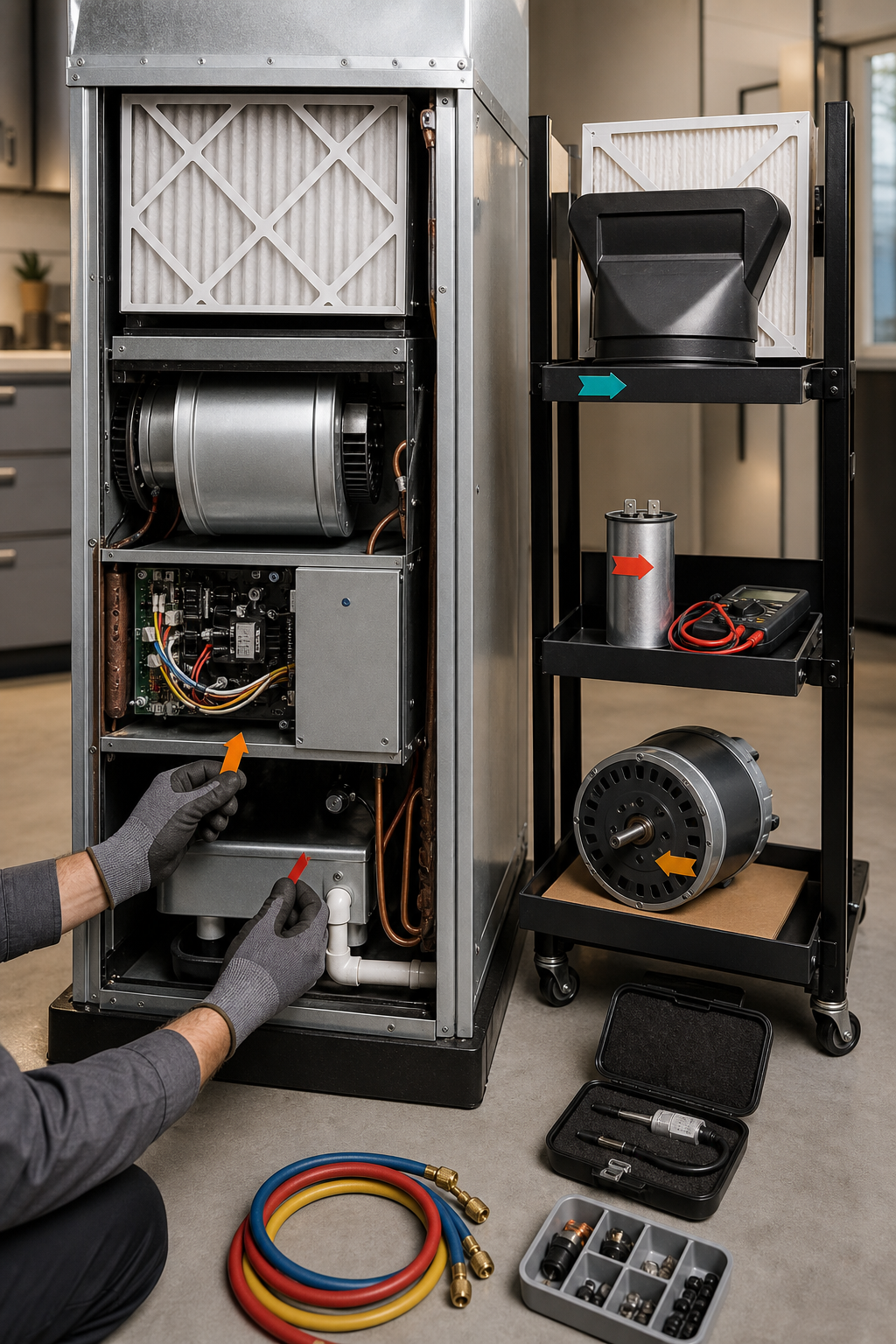
Use six filled examples for no-cooling calls, component repairs, refrigerant uncertainty, after-hours response, blower replacement, and repair-versus-replace choices.
The short answer
A service call can contain three different approvals.
First, authorize the visit and diagnostic boundary. Second, record the equipment and findings, then let the customer select a repair, temporary measure, further testing, or replacement evaluation. Third, document the completed option, observed result, remaining condition, and any follow-up.
Do not bury uncertainty inside “repair HVAC.” Identify the exact equipment, symptom, access, diagnostic fee, after-hours rate, power or comfort interruption, part and refrigerant assumptions, NTE limit, warning threshold, excluded systems, and point where work stops for another decision.
Three-stage record
Keep authorization aligned with what is known now.
- 01
Dispatch and diagnose
Record equipment/location, reported symptom, urgency, occupancy, access, operating status, diagnostic tasks, fee/rates, after-hours terms, and the diagnosis-only stop point.
- 02
Present findings and options
Identify observations and test evidence, confirmed or suspected component, manufacturer/model information, refrigerant-circuit involvement, options, part status, prices, time, and consequences of deferral.
- 03
Authorize, perform, and close
Capture selected option and decline status, exact scope, NTE or fixed price, permits where applicable, outage, tests, replaced parts, observed operation, warranty boundary, remaining issues, signatures, and copy.
Six filled examples
Approval language for common HVAC decisions.
No-cooling service call
Reported: upstairs system runs but does not maintain setpoint; first noticed [date/time]. Equipment: air handler AH-2 and outdoor unit CU-2, identifiers/photos attached. Authorized: normal-hours dispatch, visual and operational diagnostic evaluation within qualified scope, accessible filter/airflow/electrical/control/condensate observations, and customer findings report. Stop: $189 diagnostic only. Parts, refrigerant-circuit service, duct opening, access cutting, crane/lift, permit, repair, temporary cooling, and replacement proposal are excluded until separately approved. Customer provides safe access and identifies sensitive occupants/equipment.
Capacitor repair after diagnosis
Finding: qualified diagnostic record D-17 identifies the listed component at CU-1 outside the manufacturer/service criterion documented in attachment T-02; other system performance has not been fully guaranteed. Selected option: isolate equipment under contractor procedure, replace with specified compatible component, restore panels, and perform stated startup/operational observations. Price: $438 including prior diagnostic credit of $[___]. Excludes: contactor, motor, compressor, wiring beyond listed connection, refrigerant work, utility voltage, concealed damage, repeat failure from another cause, and code/permit work not identified. Warranty terms attach separately and do not promise the remaining system.
Blower motor and module replacement
Finding: AH-1 blower assembly does not operate as documented in D-22; exact motor/module supersession and availability require supplier confirmation by equipment model/serial. Authorized: source verified compatible assembly, labor $[___]/hour and materials at [basis], replace motor/module within NTE $2,450, and perform manufacturer/project-specific setup and observed-operation checks. Notify customer when part, final fixed option, lead time, and warranty source are confirmed; no order above $[___] restocking exposure without approval. Excludes: board, transformer, wheel/housing, duct, refrigerant system, access alteration, and temporary conditioning. Stop if additional failed components or incompatible field modifications are found.
Refrigerant uncertainty without a “top-off” promise
Observation: system performance data indicates refrigerant-circuit evaluation is warranted; leak source and repair scope are not yet established. Authorized: EPA Section 608-certified technician performs equipment-appropriate circuit evaluation and documents accessible findings within $620. Not authorized: automatic refrigerant addition, intentional venting, leak repair, recovery, component opening, refrigerant conversion, or replacement. If further service is proposed, the next approval identifies refrigerant type, equipment charge information where available, located/suspected leak, repair method, recovery/reclamation requirements, quantity/price basis, verification applicable to this appliance, records, and system limitations. Federal leak-repair thresholds are not assumed to apply to every residential unit.
Weekend loss of heating or cooling
Reported: occupied [home/business] has [condition], including customer-identified vulnerable occupants, product/process, or freeze concern; contractor does not independently classify an emergency. Authorized: after-hours dispatch $[___], labor $[___]/hour, diagnostic work and limited repair using stocked parts within NTE $950; call customer at 70% and stop before exceeding. Customer decisions: access, alarm/security, power interruption, occupied-area conditions, temporary equipment, and whether normal-hours follow-up is acceptable. Excludes: special-order parts, refrigerant, major component, permit, roof/lift/crane, duct access, remediation, hotel/business loss, and replacement. No guarantee of same-visit restoration.
Major component failure on aging matched system
Finding: diagnostic record D-31 identifies [component/system condition]; equipment identifiers, age information source, refrigerant, prior repair history supplied by customer, and current operating status attached. Option A: defined repair $[___], part lead time [___], stated parts/labor warranty source, excluded adjacent components, and no extension of manufacturer system warranty. Option B: paid replacement evaluation $[___] covering load/site/duct/electrical/permit/product options; it is not authorization to install. Option C: decline both, leave system [safe/off/status], receive findings and next-step notice. Customer selects one; contractor does not claim repair or replacement is universally superior without project facts.
Option design
Give each choice its own finish line.
Information is the deliverable
Define tests/observations, access, fee, time limit, report, and what cannot begin without a second approval.
Name the component and system boundary
State part, compatibility basis, labor, setup, observed result, exclusions, price, lead time, and warranty source.
Do not imply permanent restoration
Record operating limits, monitoring, end date, customer instructions, risk, follow-up, price, and whether temporary equipment is included.
Evaluation is not installation
Separate survey/design/selection from equipment purchase, permit, demolition, installation, startup, commissioning, and warranty registration.
Reusable field sheet
HVAC staged repair authorization
Keep the equipment identity, diagnostic record, customer option, and closeout result connected under one project.
Create a repair approval with JobSign →- Customer, site, and authority
- [Owner/manager, property/area, requester, signer authority, access contact, occupancy/process concern]
- Equipment identity
- [System/unit ID, indoor/outdoor components, location, manufacturer/model/serial photos, fuel/voltage/refrigerant if verified]
- Reported symptom
- [Customer’s words, first noticed, intermittent/continuous, zones affected, alarms/noise/odor/water, prior work, current status]
- Diagnostic authorization
- [Normal/after-hours dispatch, included evaluation, access, power/operation, fee/rates, time/NTE, report, explicit diagnosis-only stop]
- Findings and evidence
- [Observed/tested facts, confirmed vs. suspected cause, component, photos/readings, manufacturer/service source, unresolved conditions]
- Options and selection
- [Repair, further diagnosis, temporary measure, replacement evaluation, decline; scope/price/time/result for each; selected/declined]
- Parts and refrigerant
- [Exact part/supersession, stock/special order, deposit/restocking, lead time, refrigerant type/quantity basis, certified scope, records]
- Price controls
- [Fixed/unit/T&M/NTE, dispatch, labor, materials, equipment, subcontract, permit, tax/markup, diagnostic credit, warning threshold]
- Access, outage, and schedule
- [Roof/attic/crawl/occupied area, lift/crane, power/fuel/comfort interruption, notices, temporary equipment, added days, dependencies]
- Repair, test, and closeout
- [Exact work, setup, project-specific checks/observed operation, replaced parts disposition, photos, remaining condition, instructions]
- Warranty and exclusions
- [Manufacturer/parts/labor source and term as documented; excluded components/systems, ducts, electrical, structure, finishes, losses]
- Approval
- [What signature authorizes, limit/stop point, customer/contractor names, authority, signatures, timestamps, completed copy]
Use qualified and licensed people, manufacturer service information, EPA-certified technicians where required, permits and inspections where applicable, and current federal, state, and local rules. This form does not diagnose equipment or promise performance.
Pre-send audit
Six checks before the customer chooses.
- 01
Identify the exact equipment
Do not let an approval for one condenser, air handler, zone, rooftop unit, or thermostat silently expand to the whole property.
- 02
Separate symptom, evidence, and conclusion
Preserve customer report, technician observations, test basis, confirmed finding, remaining uncertainty, and alternate-system exclusions.
- 03
Make every option independently complete
Each choice needs its own scope, expected result, price, lead time, outage, limitation, warranty source, and next decision.
- 04
Control uncertain money
Define rates, NTE amount, what counts toward it, warning percentage, stop point, special-order exposure, and new-approval trigger.
- 05
Verify refrigerant applicability
Identify equipment, refrigerant and charge information where available, activity, certification, records, and rule applicability without copying large-system requirements onto every unit.
- 06
Close the loop
Document work performed, parts, project-specific observed result, remaining issue, customer instructions, follow-up, invoice, and completed copy.
Research basis
Refrigerant service needs specific equipment facts, not boilerplate.
EPA says Section 608 certification is required when stationary refrigeration or air-conditioning maintenance, service, repair, or disposal could reasonably be expected to violate the integrity of covered refrigerant circuits. EPA also distinguishes a leak-location inspection from readings that merely suggest a system may be leaking. That supports a staged authorization: document the evidence and exact certified scope before promising refrigerant addition or repair.
EPA’s leak-repair and record rules vary by refrigerant, appliance type, charge size, leak rate, and current regulatory program. For example, some Section 608 requirements focus on appliances containing 50 or more pounds of ozone-depleting refrigerant, while EPA’s HFC program has separate current provisions for certain appliances. Verify applicability for the actual unit rather than pasting commercial-system thresholds into a residential form.
- EPA: Section 608 technician certification ↗
- EPA: Section 608 technician questions and answers ↗
- EPA: stationary refrigeration leak-repair requirements ↗
- EPA: current HFC management regulatory actions ↗
This guide is a documentation aid, not HVAC, refrigerant, electrical, combustion, safety, engineering, warranty, or legal advice. Verify equipment, hazards, certification, license, product instructions, permits, adopted rules, and contract terms for the actual project.
HVAC repair authorization questions
What belongs in an HVAC repair authorization?
Customer and equipment identity, symptom, diagnostic scope and fee, findings, option selected, parts/refrigerant assumptions, price or limit, time, tests, warranty boundary, exclusions, evidence, and signatures.
Does the diagnostic fee approve repair?
Only if the signed terms clearly include a defined repair and price. A staged form can stop after diagnosis and ask the customer to select the next option.
How should uncertain cost be controlled?
Use a fixed diagnostic stage, then fixed repair pricing when known or T&M/NTE terms with rates, warning threshold, exclusions, and stop point.
Who can service the refrigerant circuit?
EPA Section 608 certification applies to covered stationary-equipment service that could violate refrigerant-circuit integrity. Verify the technician type, equipment, refrigerant, activity, and current rules.
One clear repair decision
Connect the diagnosis, selected option, price limit, and result.
JobSign helps repair pros attach findings, present the next authorized step, collect signatures, and share the completed approval.
Explore repair approvals →