
Contractor field guide · Free template
Don’t approve an “equivalent.” Approve the differences.
When the specified product is unavailable, delayed, discontinued, or no longer practical, compare the proposed substitute in terms the customer and project team can actually evaluate.
The short answer
A substitution approval documents a changed product decision.
Identify the exact original product, the exact proposed substitute, why the change is requested, and every meaningful difference in appearance, dimensions, performance, certification, installation, maintenance, availability, price, schedule, and warranty.
Customer acceptance does not establish technical equivalence. Required technical, design, manufacturer, permit, or code review remains a separate gate.
Side-by-side review
Compare what matters on this job.
Attach product data, samples, photos, and written findings. Mark unknowns as unknown instead of presenting assumptions as facts.
- 01
Identity and reason
Record both manufacturers, model numbers, finishes, and quantities. Explain whether the trigger is availability, lead time, damage, design, cost, or field compatibility.
- 02
Appearance and dimensions
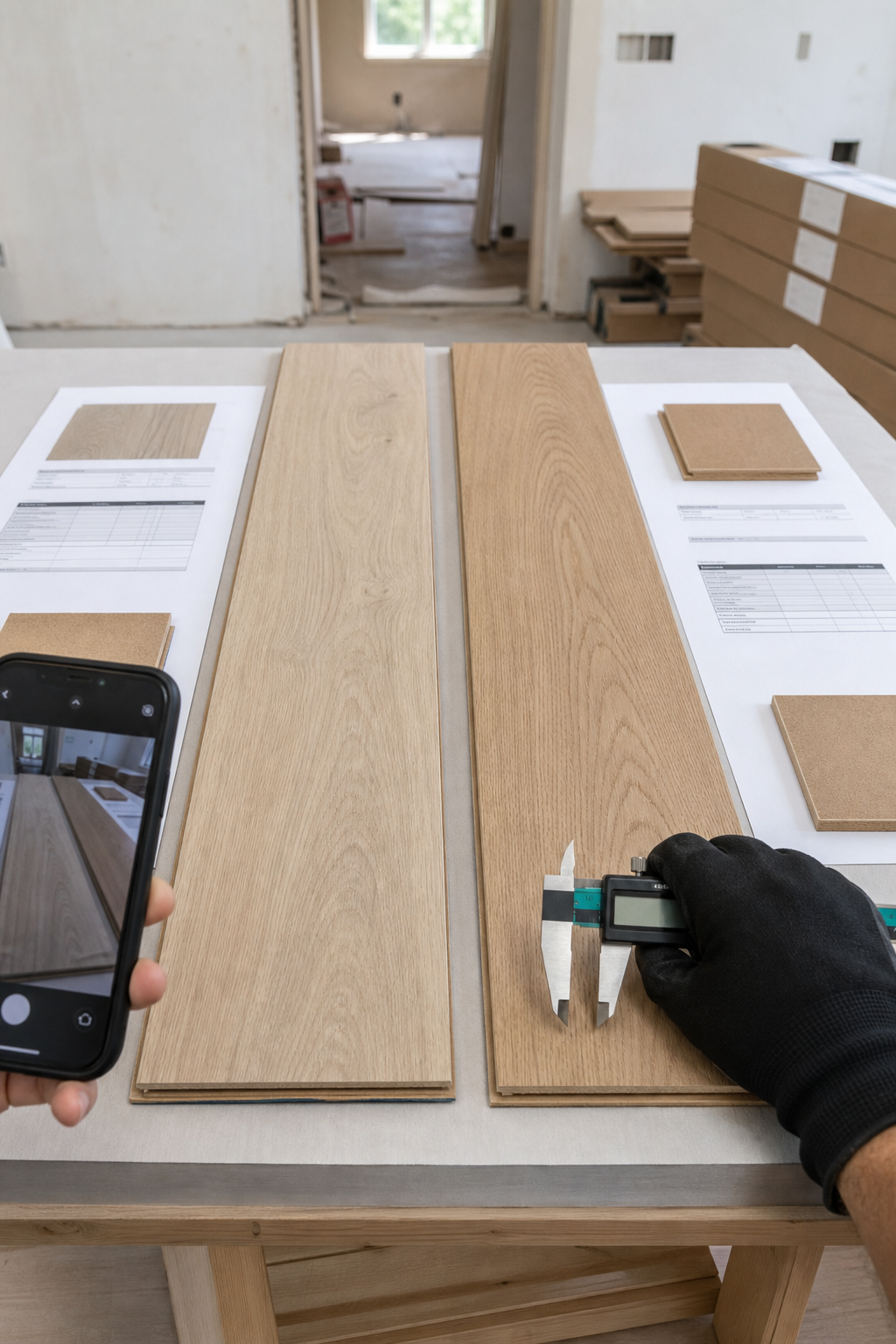
Compare color, pattern, texture, profile, thickness, size, tolerances, transitions, and visible variation using actual samples where practical.
- 03
Performance and certification
Compare ratings, capacity, materials, listings, evaluation reports, efficiency claims, installation instructions, and conditions of use.
- 04
Installation and adjacent work
Identify changed preparation, fasteners, adhesives, labor, accessories, clearances, substrate, controls, trim, or future service requirements.
- 05
Commercial effect and approvals
State price credit or addition, lead time, schedule effect, warranty differences, and every required customer or technical approval.
Copyable template
Material substitution approval
Use one approval per related substitution set. Attach supporting records rather than compressing technical differences into “same or better.”
Create and sign it with JobSign →- Project & affected scope
- [Customer, property, room/area, contract item, drawing/specification or selection reference]
- Originally specified
- [Manufacturer, product, model/SKU, finish, size, quantity, quoted source]
- Reason for substitution
- [Unavailable, discontinued, lead time, damage, compatibility, price, design revision, or customer request]
- Proposed substitute
- [Manufacturer, product, model/SKU, finish, size, quantity, proposed source]
- Appearance & dimensional differences
- [Color, grain/pattern, texture, profile, thickness, dimensions, tolerances, and sample/photo references]
- Performance & compliance differences
- [Materials, ratings, capacity, certification/listing, evaluation report, efficiency, and conditions of use]
- Installation impact
- [Preparation, labor, accessories, controls, fasteners/adhesives, transitions, adjacent work, or maintenance]
- Price effect
- [Credit $___ / addition $___ / no change; include tax, freight, restocking, labor, and related work]
- Schedule effect
- [Original and substitute lead times; revised milestone or completion effect]
- Warranty & service
- [Product and workmanship coverage differences, claim route, replacement availability, and exclusions]
- Required reviews
- [Designer, engineer, manufacturer, supplier, inspector, permit revision, or authority approval; status and reference]
- Decision boundary
- [Approval authorizes only the described substitute; additional changes require separate written approval]
Adapt this operational template to the contract, design documents, product, trade, and jurisdiction. It is not legal advice or a technical equivalency determination.
Three completed examples
Show the decision, not just the replacement name.
Discontinued oak plank
Original: 7-inch, 12 mm light oak. Substitute: 7.5-inch, 10 mm warmer oak. New transition profiles and 2-day lead-time improvement; sample and price credit attached.
Unavailable shower valve trim
Original: selected trim in brushed finish. Substitute: same manufacturer’s current series. Rough valve compatibility confirmed in writing; handle shape and warranty term differ.
Alternate composite decking
Original: specified capped board. Substitute: alternate profile and fastening system. Color sample, evaluation report, span/fastener review, labor addition, and designer approval required.
Four stop points
Customer preference cannot answer every technical question.
Structural or assembly change
Route load path, span, fire, weather, waterproofing, or engineered-system changes to the qualified project professional.
Approved documents differ
Determine whether the permit set, energy documentation, product approval, or inspector review must change.
Manufacturer compatibility
Confirm components, substrates, accessories, controls, and instructions when a system warranty or listing depends on them.
Certification is part of the sale
Verify the exact model in the relevant directory when efficiency, safety listing, or evaluation-report status matters.
Research basis
Specific products and verifiable claims matter.
California CSLB advises that home-improvement contracts describe products in detail, including style, manufacturer, model, quality, and quantity, and says covered price or scope changes must be documented through written change orders signed before changed work begins. Oregon CCB’s public sample change order likewise provides fields for the changed work, price, schedule, and acceptance.
For technical claims, use the record relevant to the product. ICC-ES evaluation reports identify evaluated products, code provisions, installation guidance, and conditions of use. ENERGY STAR’s Product Finder identifies certified products by model and features. UL Product iQ provides certification information and alternate-product search. These directories support review; they do not replace project-specific approval.
- California CSLB: Home Improvement Contracts ↗
- Oregon CCB: Sample Change Order ↗
- ICC-ES: Evaluation Reports ↗
- EPA ENERGY STAR Product Finder ↗
- UL Solutions: Product iQ ↗
This guide provides general operational information. It does not establish product equivalence, code compliance, design adequacy, warranty coverage, or legal sufficiency for a particular project.
Material substitution questions
Is an “equivalent product” automatically acceptable?
No. Compare the project’s actual requirements and obtain every required technical and contractual review. Similar marketing language does not prove matching dimensions, ratings, compatibility, installation, or warranty.
Does a material substitution need a change order?
Often it should be documented as or attached to one when the contract’s products, price, scope, schedule, or warranty changes. Follow the contract and applicable local requirements.
Who approves the substitute?
The customer’s decision may be only one step. Designers, engineers, manufacturers, inspectors, permit authorities, or other qualified parties may also need to review it.
What if the substitute saves money?
Show the full credit calculation, including material, freight, restocking, labor, accessories, and related work. Record whether the customer receives a credit and whether schedule or warranty terms also change.
Before ordering
Put the product comparison beside the signature.
Describe the original and substitute, attach samples and data, record every effect, and send the customer a JobSign approval before purchase or installation.
Get JobSign →