
Field-decision guide · Permitted work
Keep the correction notice separate from the priced solution.
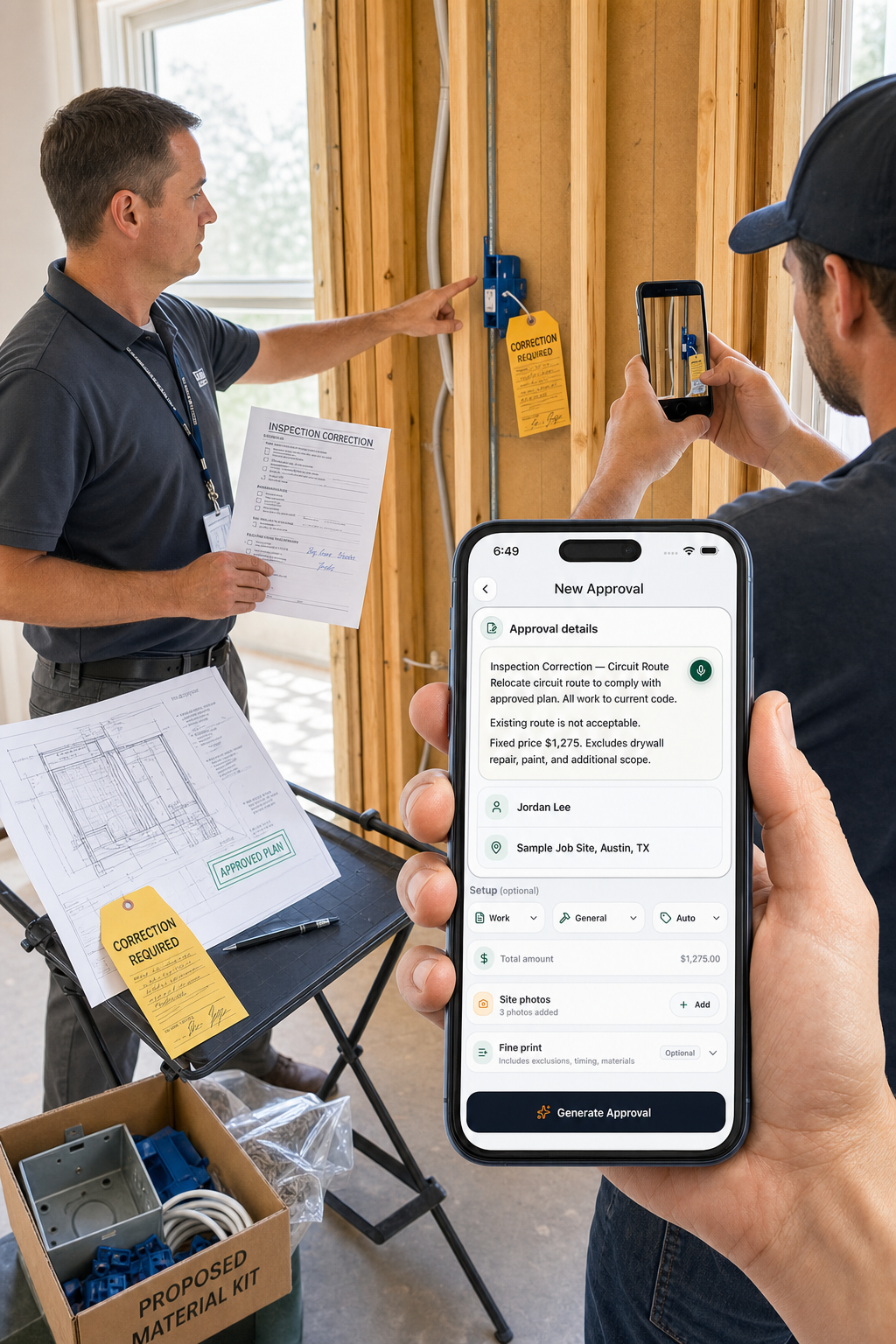
Connect the official inspection record to qualified interpretation, exact corrective scope, permit or plan changes, price, schedule, reinspection, and customer authorization without overstating liability or approval.
The operating principle
Quote the record; do not paraphrase it into a verdict.
Attach the official inspection report, correction notice, portal entry, marked plan, or written authority communication. Record date, inspection type, permit, inspector/department, item number, exact location, and deadline. If the comment was oral, request the authority’s normal written record or document the conversation neutrally and identify it as unconfirmed.
Then ask what the record actually requires next: simple correction, contractor clarification, designer/engineer response, revised detail, construction change, new permit, product information, test, owner selection, or another inspection. Only after that step should the contractor propose and price the exact work.
Eight-step workflow
Move from inspection item to authorized correction.
- 01
Preserve the official record
Save the permit, inspection date/type, status, item number, exact wording, deadline, photos, marked plan, and portal/report source.
- 02
Identify the affected baseline
Cite the contract line, approved plan/detail, specification, submittal, RFI, prior change, existing-condition assumption, and responsible trade.
- 03
Classify the next decision
Separate field correction, clarification, design/engineering, plan revision, permit change, product documentation, test, or owner selection.
- 04
Get qualified interpretation
Route technical or design questions to the responsible architect, engineer, manufacturer, authority, licensed trade, or other qualified party.
- 05
Define the contractor proposal
List exact removal, protection, material, installation, access, testing, restoration, documentation, permit, and reinspection coordination.
- 06
Price and schedule the delta
Show labor, material, equipment, subcontract/design, fees, tax/markup, credits, payment, lead time, added days, and dependencies.
- 07
Obtain customer authority
Follow the contract and applicable law before added work begins; preserve unresolved responsibility without silently waiving rights.
- 08
Close through reinspection
Capture completion evidence, approved documents, test results, reinspection request/status, fees, remaining items, and completed copy.
Neutral customer script
Explain the situation without blame or a blank check.
“The inspection produced a written item.”
“At the [date/type] inspection for permit [ID], the department recorded item [number] at [location]. The exact report is attached.”
“We are verifying the required response.”
“The notice identifies the condition, but the correction may need clarification or a detail from [responsible party] before we price work.”
“This change prices one defined correction.”
“Our proposal includes [scope], [documents/tests], and reinspection coordination for $[___], adding [___] days, subject to listed dependencies.”
“The authority controls acceptance.”
“Approval authorizes this scope; it does not decide fault, waive contract rights, or guarantee that no further authority comment will arise.”
Completed example
Inspection item, design response, and field work remain traceable.
Correction item 04
City of [___], permit [P-___], framing inspection [date], report item 04: “[exact short wording from attached official record].” Location J-03 at garage-to-house wall. Reinspection required before concealment. Inspector did not price work or assign contract responsibility.
Revised detail A-5R1
Architect/engineer of record issued written response [ID/date] showing revised backing, fastener, and board termination at J-03. Contractor relies on that detail for this proposal; design services and other locations are excluded.
Fixed $2,460 · +2 working days
Protect area; remove only marked board section; install listed backing/material per A-5R1; restore listed assembly layers; provide completion photos; coordinate one reinspection. Includes ordinary access and disposal. Excludes hidden damage, hazardous material, other junctions, painting, designer fees, permit revision beyond listed response, reinspection fees above one visit, and further authority requirements.
Proceed without deciding liability
Customer authorizes $2,460 and two added working days so correction can proceed. Payment/responsibility is handled under the contract and stated reservation; this approval does not admit fault, waive claims or defenses, or guarantee inspection acceptance. New or materially different work requires another written decision.
Reusable field sheet
Inspection-driven change
Never replace the official notice with this summary; attach it.
Create an inspection change order with JobSign →- Authority and inspection
- [Department/AHJ, permit, inspection type/date/status, inspector/reference, deadline, reinspection requirement]
- Official item
- [Report/correction number, exact quoted wording or faithful neutral summary, location, attachment and portal source]
- Contract baseline
- [Agreement line, approved plan/detail/spec, submittal/RFI/prior change, existing-condition assumption, responsible party]
- Interpretation path
- [Clarification, architect/engineer/manufacturer/AHJ response, revised detail, construction change, permit, test, owner selection]
- Proposed corrective scope
- [Protection, removal, exact installation/material, access, testing, restoration, documentation, permit/reinspection coordination]
- Price and payment
- [Labor, material, equipment, subcontract/design, fees, tax/markup, credit, fixed/unit/T&M/NTE, payment timing]
- Schedule
- [Decision deadline, lead time, added days, inspection/design/permit dependencies, concealment hold, remobilization]
- Exclusions and uncertainty
- [Other items/locations, hidden conditions, design, hazardous material, finishes, added fees, further authority requests]
- Responsibility reservation
- [How cost responsibility is handled; no admission/waiver unless intended; contract notice and dispute rights preserved]
- Approval and closeout
- [Customer/contractor authority/signatures/timestamps, completed copy, completion evidence, reinspection request/result]
Use the actual authority record, approved documents, contract, qualified design or trade interpretation, permit process, and jurisdictional requirements. A change order does not override the building official or guarantee inspection approval.
Research basis
Correction processes are authority-specific.
San Diego’s professional-certification guidance illustrates that an inspector may issue a correction notice and, depending on severity, require a new permit or construction change. Seattle Fire explains that its correction notices identify problems and deadlines and that reinspections verify correction; supporting documentation and the original report matter.
California CSLB offers one contract-law example: covered home-improvement scope or price changes require a written change order signed before changed work begins. These local and state procedures are examples only. Use the actual authority, contract, and jurisdiction for the project.
- City of San Diego: correction notice and construction change ↗
- Seattle Fire: correction notices and reinspections ↗
- California CSLB: written change orders ↗
Documentation guidance only, not code, design, engineering, inspection, contract, licensing, or legal advice. Verify every requirement with the actual authority and qualified project professionals.
Inspector-required change order questions
What belongs in the change order?
Authority, permit, inspection record, exact item, interpretation path, proposed scope, price, time, reinspection, exclusions, and approval.
Is an inspector comment automatically a change?
No. Preserve the official record, determine the required response and contract baseline, then price the exact proposed scope.
Who is responsible for the cost?
That depends on contract, documents, law, design duties, existing conditions, workmanship, and the actual correction. Avoid deciding liability by label.
Does correction guarantee approval?
No. The authority controls reinspection. State documents, tests, fees, dependencies, and the possibility of additional requests.
One traceable correction
Connect the official inspection item to a signed field-ready scope.
JobSign helps contractors attach the report, define and price the correction, collect approval, and share the completed PDF.
Explore change order approvals →