
Emergency field guide · Water loss
Authorize the immediate response without authorizing the unknown.
Separate source and safety status, extraction, protection, drying equipment, monitoring, selective removal, specialty hazards, contents, reconstruction, and insurance communication into controlled phases.
The operating principle
Move quickly, but make the authorization smaller than the uncertainty.
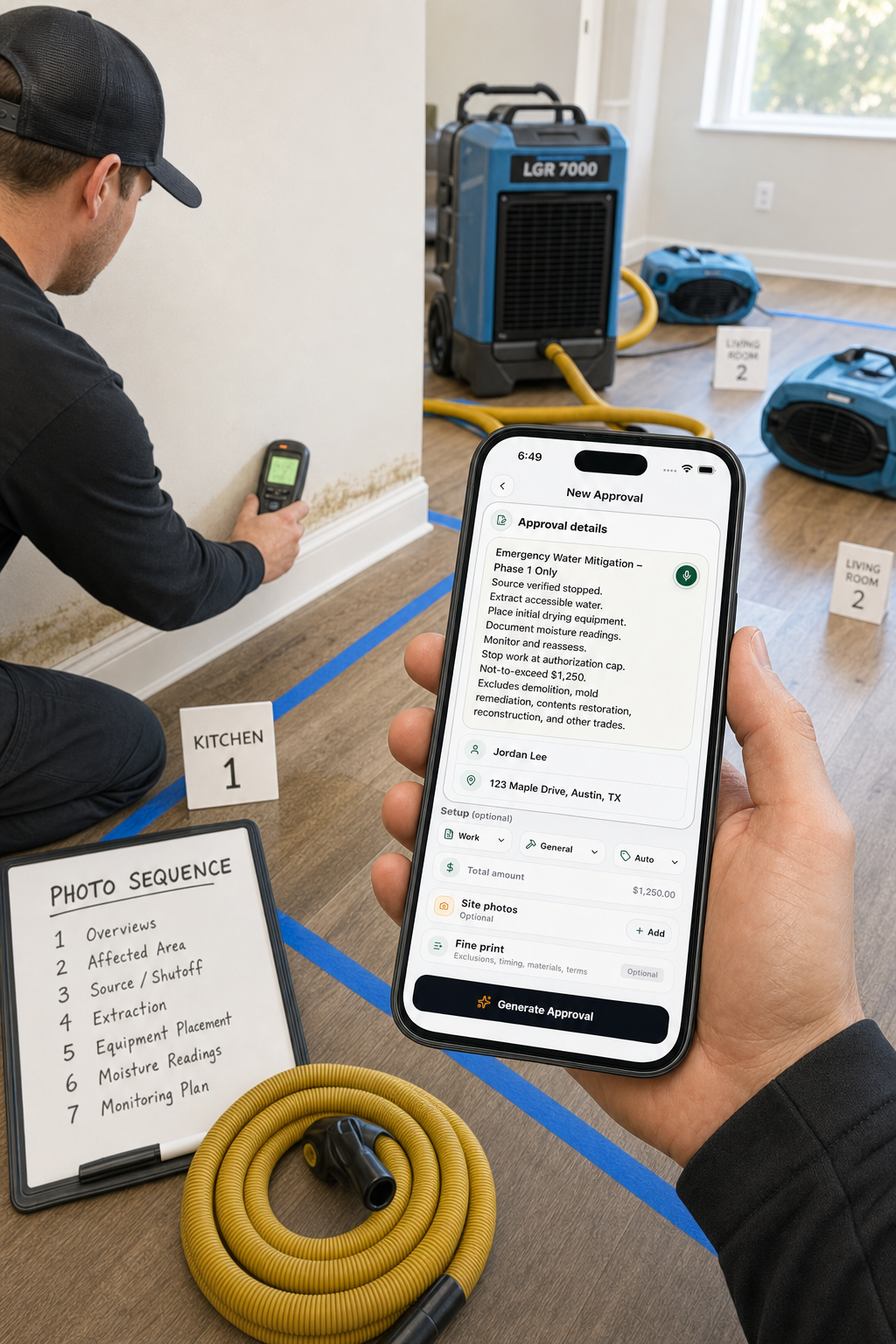
Emergency work often begins before the full wet boundary, material condition, drying plan, contamination status, or reconstruction scope is known. That uncertainty is a reason to authorize a limited first phase—not to use an unlimited “perform all necessary services” clause.
Document safety and source status first. Then name the immediate objective, rooms, methods, equipment assumptions, rates, monitoring cadence, cap, and stop conditions. Take overview and close-up photos before cleanup when safe, preserve required samples and receipts, and never promise that an insurer will cover the work or accept the contractor’s price.
Five-phase authorization
Each phase earns its own scope and decision.
- 00
Safety and source status
Record safe entry, electricity/gas/structural concerns, water source and whether stopped, active leakage, affected utilities, occupancy, contamination indicators, and emergency contacts.
- 01
Emergency stabilization
Authorize accessible-water extraction, migration control, protection, initial moisture documentation, limited contents movement, equipment placement, and a firm NTE or time window.
- 02
Monitored drying and selective removal
After mapping findings, approve room-specific equipment, monitoring visits, target/benchmark method, justified openings or removal boundaries, disposal, and updated cap.
- 03
Specialty hazard or remediation scope
Use qualified assessment and separate authorization for suspected asbestos/lead, sewage or chemical contamination, mold remediation, structural issues, or other regulated hazards.
- 04
Reconstruction and contents restoration
Price rebuild, finishes, cabinetry, flooring, personal-property cleaning/storage, permits, code upgrades, selections, schedule, and warranty separately from mitigation.
Immediate stop rules
Pause when the authorized problem changes shape.
Water remains active or the site is unsafe.
Stop beyond immediate protection when source control is unverified, electricity/gas/structure presents danger, access is prohibited, or the loss conditions differ materially from intake.
Moisture extends beyond named rooms or assemblies.
Map and document the new boundary, protect unaffected property, and request approval before expanding equipment, openings, removal, or labor beyond the phase.
Suspected hazard or changed water condition appears.
Do not improvise mold, asbestos, lead, sewage, chemical, or regulated-material procedures. Isolate as appropriate and route to qualified assessment and separate scope.
The cap, equipment-days, visits, or target window will be exceeded.
Provide current readings, work completed, equipment log, forecast, revised option, and customer decision before accruing unapproved charges except as the agreement/law permits.
Completed Phase 1 example
Supply-line loss with a defined first-day boundary.
Kitchen supply line · source stopped
Customer shut off angle stop at 7:40 a.m.; plumber verified no active flow at 8:25. Visible water in kitchen and adjacent dining edge; lower cabinet toe-kick and engineered-wood edge read elevated. No basement. Electricity remains on; cords and equipment require protected outlets and approved routing.
Document, extract, protect, stage drying
Overview/source/water-line photos; moisture map at named rooms; extract accessible water; protect traffic path; move up to six light contents within rooms; lift removable toe-kick only if non-destructive; place up to two air movers and one dehumidifier; initial equipment log; one next-day monitoring visit.
Not to exceed $1,250 without new approval
Emergency labor $165/hour per technician, two-person maximum for four hours; extractor $185 event; air mover $38/day each; dehumidifier $125/day; monitoring $145/visit; ordinary protection/material at cost plus disclosed 15%. Stop before NTE. Equipment beyond 48 hours requires updated readings and approval.
No demolition, remediation, or reconstruction
Excludes cabinet/drywall/floor removal, mold or hazardous-material assessment/remediation, sewage/chemical loss, contents cleaning/storage, structural/electrical/plumbing repair, finish restoration, reconstruction, permit, and insurance negotiation. Hidden spread, unsafe condition, suspected hazard, or expanded equipment triggers stop, documentation, and Phase 2 proposal.
Room-by-room field sheet
Mitigation authorization
Authorize one phase, one cap, and clear stop conditions.
Create a mitigation approval with JobSign →- Customer, site, and loss
- [Customer/authority, address, contact, date/time discovered, cause/report, claim number if supplied]
- Safety and source status
- [Safe entry, source active/stopped/unknown, electricity/gas/structure, occupancy, contamination indicators]
- Affected-area baseline
- [Room/zone, material/assembly, visible condition, water line, initial reading/location/unit, unaffected reference]
- Authorized phase/objective
- [Phase 0/1/2/3/4, immediate outcome, named rooms/assemblies, start/decision deadline]
- Methods and limits
- [Extraction, protection, contents movement, openings/removal boundary, disposal, cleaning; prohibited work]
- Equipment schedule
- [Type/ID, room, count, daily/event rate, placement/start, approved days, power/duct/condensate plan]
- Monitoring plan
- [Visit rate/count/cadence, readings/locations, ambient data, benchmark/target method, adjustments, reports]
- Labor/material rates
- [Emergency/regular/after-hours labor, crew cap, consumables, equipment, subcontract, markup/tax/fees]
- Price control
- [Fixed/unit/T&M, estimate, NTE, deposits/payment, what counts toward cap, warning and hard stop]
- Access, contents, and evidence
- [Keys/occupancy/pets, utilities, contents inventory/movement, photos/video/samples/receipts, daily log]
- Stop and escalation
- [Source/safety change, hidden spread, contamination/hazard, structural/electrical, cap/days/visits exceeded]
- Exclusions and next approval
- [Remediation, hazards, reconstruction, contents restoration, insurance coverage; decision owner/time, signatures/copy]
The contractor does not determine insurance coverage or guarantee payment, drying duration, salvageability, absence of hidden damage, or mold prevention. Use qualified professionals and separate authorization for regulated hazards, remediation, and reconstruction.
Research basis
Document first when safe, dry promptly, and preserve phase boundaries.
EPA states that moisture control is central to mold prevention and that water-damaged areas and items should be dried within 24–48 hours where possible. Its flooded-home guidance also warns that floodwater can carry sewage or chemicals and that cleanup may require qualified professionals.
NFIP guidance recommends clear overview and close-up photos/video before cleanup when safe, recording appliance serial numbers, keeping appropriate samples and receipts, logging insurer/contractor conversations, protecting undamaged property, and discussing coverage with the insurer. These insurance resources do not promise coverage for a contractor’s scope or rates.
- EPA: moisture control and 24–48 hour drying guidance ↗
- EPA: flooded-home hazards and qualified help ↗
- NFIP: document damage before cleanup ↗
- NFIP: claim, conversation, sample, and receipt records ↗
- FEMA: safety, documentation, and insurer consultation ↗
Documentation guidance only, not restoration, remediation, environmental, safety, electrical, structural, insurance, or legal advice. Follow qualified standards and local requirements.
Water mitigation authorization questions
What belongs in the authorization?
Source/safety, rooms/readings, phase, methods, equipment/rates, monitoring, labor/material rates, NTE, access/contents/evidence, stops, exclusions, next decision, and signatures.
Is mitigation the same as reconstruction?
No. Stabilization, drying, removal, remediation, contents, and reconstruction are separate scopes and decisions.
Will insurance pay?
The policy and insurer decide coverage and payment. The contractor should not promise coverage or price acceptance.
When should work stop?
At the scope/cap and when source, boundary, contamination, hazard, safety, equipment, duration, or proposed phase materially changes.
One controlled emergency phase
Use JobSign to define the response before uncertainty becomes open-ended scope.
Describe the immediate work, attach site photos, set the cap and exclusions, collect approval, and share the signed PDF.
Explore repair approvals →