
Field-decision guide · Repair choices
Compare the same facts before choosing a different path.
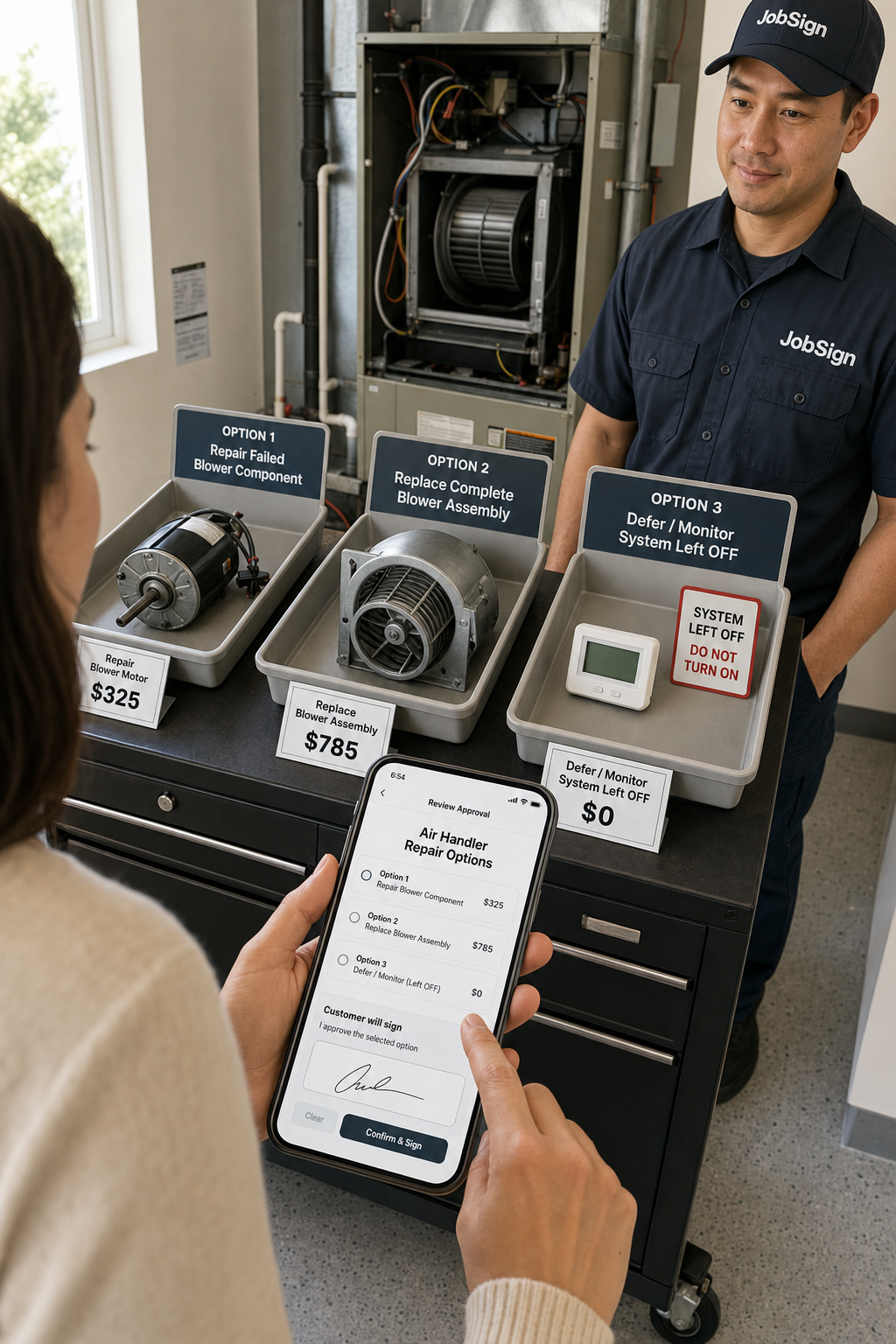
Present repair, replacement, monitoring, or decline options with comparable scope, price, outcome, downtime, warranty, uncertainty, and exclusions—then record one informed selection.
The operating principle
Normalize the comparison before naming a winner.
“Good, better, best” is only useful if every column answers the same questions. A low-price repair can look artificially complete when its unresolved condition, shorter warranty, repeat-failure exposure, or added diagnostic work is buried. A replacement can look artificially attractive when accessories, permits, restoration, disposal, operating assumptions, or lead time are omitted.
Use neutral option names first—component repair, assembly replacement, complete system replacement, monitor, or decline. If the contractor recommends one, state the technical and customer-specific basis. Keep total price and material limitations equally prominent and leave every selection unchecked until the customer acts.
Eight-step workflow
Build options from one verified baseline.
- 01
Identify the decision
Record customer, asset, location, complaint, work order, decision-maker, timing need, budget or downtime constraints, and current operating status.
- 02
Freeze findings and uncertainty
List tests, measurements, confirmed condition, suspected cause, diagnostic limits, unopened areas, and additional steps that could change the choices.
- 03
Remove nonviable choices
Exclude options that conflict with safety, code, licensing, manufacturer requirements, compatibility, parts availability, or qualified judgment—and say why.
- 04
Define each scope independently
State exact parts, labor, access, removal, installation, testing, controls, restoration, permits, disposal, startup, and customer responsibilities.
- 05
Compare one row set
Show total price, outcome, unresolved condition, downtime, schedule, dependencies, warranty, service horizon, operating effect, exclusions, and triggers.
- 06
Explain recommendation and incentives
Connect any recommendation to findings, age, history, risk, customer priorities, and evidence; disclose material limitations or conflicts.
- 07
Capture one affirmative selection
Record selected option/version, price, schedule, financing or payment terms, customer authority, and explicit status of every unselected option.
- 08
Carry selection into work
Create the work order from the chosen scope only, attach the comparison, set the change/stop rule, deliver a copy, and preserve the decision record.
Equal comparison rows
Make every option answer twelve questions.
What changes, what remains, and what parts are used?
Show exact work, original/new/remanufactured/customer-supplied parts, access and restoration, and the old condition that remains after the option.
What is the total, what could change it, and how long is service interrupted?
Include diagnosis credit, labor, parts, fees, tax, permit, disposal, total, payment, lead time, field duration, and not-to-exceed or change trigger.
What outcome is expected, for how long, and under what assumptions?
Describe restored function—not “like new”—plus expected service horizon as an estimate, performance assumptions, monitoring, and known repeat-risk.
What warranty applies, what is excluded, and what could invalidate the option?
State parts/labor coverage, provider, term, registration/maintenance, excluded causes or components, compatibility, and conditions requiring another decision.
Three completed comparisons
The right answer depends on the same visible tradeoffs.
Capacitor repair · compressor repair path · system replacement
$420 component repair: replace failed capacitor, test startup; restores operation if no secondary fault; 90-day labor/one-year part; aging compressor and refrigerant circuit remain. $3,850 further repair path: recover/open system and replace compressor if confirmed, subject to contamination finding and revised scope; 2–4 days parts. $11,900 replacement: matched listed system, removal, startup and permit included; duct correction/electrical upgrade excluded. Recommendation basis states age, repair history, comfort, efficiency, and customer ownership horizon—not price alone.
Spot repair · accessible branch replacement · monitor/decline
$690 spot repair: replace visible failed fitting and test accessible section; wall patch/paint excluded; adjacent same-age piping remains. $2,480 branch replacement: replace accessible hot-water branch from manifold to two fixtures, two openings and test included; concealed routing may require change authorization. Monitor/decline: no repair, water remains off to branch; customer receives isolation and reauthorization instructions. No option promises that unexposed piping is defect-free.
Control repair · sealed-system diagnosis · replacement decision
$540 control repair: replace confirmed failed board, verify commands; cooling outcome depends on compressor response; part may be return-restricted. $295 additional diagnosis: authorize sealed-system pressure/electrical tests under a stop limit before pricing compressor work. Replace appliance: no appliance sale by contractor; diagnostic fee due, unit left unplugged if unsafe, customer independently selects replacement. The form separates a repair estimate from a recommendation to shop elsewhere.
Reusable comparison sheet
Repair options approval
Use the same fields and visual weight for every viable choice.
Create repair options with JobSign →- Decision context
- [Customer/authority, asset/location/model, complaint, work order, current status, priorities/constraints]
- Findings and confidence
- [Tests/measurements, confirmed condition, suspected cause, diagnostic limits, attachments]
- Option title and scope
- [Neutral name; exact parts/labor/access/removal/install/testing/restoration/permit/disposal]
- Parts and compatibility
- [New/remanufactured/used/customer-supplied, specification, matched components, availability]
- Expected result
- [Function restored or condition managed, assumptions, performance range, no unsupported guarantee]
- Condition remaining
- [Components/risks not corrected, known age/history, monitoring, repeat-failure exposure]
- Total price
- [Diagnosis credit, labor, parts, fees/tax/permit/disposal, total, payment, financing, price expiration]
- Time and dependencies
- [Lead time, downtime, field duration, access, utility, permit, parts, customer prerequisites]
- Warranty and horizon
- [Parts/labor provider and term, registration/maintenance, expected service horizon and basis]
- Operating-cost effect
- [Known or estimated energy/water/maintenance difference, assumptions, source; no savings guarantee]
- Exclusions and change triggers
- [Hidden conditions, other components/finishes, failed test, unavailable part, revised price/stop rule]
- Selection and authorization
- [Selected option/version/total; unselected options; customer/contractor authority, signature/time, copy]
Present only viable choices supported by qualified findings. Keep material terms clear and equally visible. Further diagnosis, hidden conditions, codes, manufacturer instructions, or parts findings may require a revised recommendation and new authorization.
Research basis
Comparable terms support an affirmative choice.
FTC auto-repair guidance provides a useful written-estimate pattern: identify the condition, parts, anticipated labor, and approval threshold. FTC dark-pattern guidance warns against burying key terms, limitations, or fees and against designs that steer choices through false urgency or hidden information.
ENERGY STAR’s HVAC replacement guidance demonstrates why replacement is not simply the highest-price column: equipment age, repeat problems, comfort, operating performance, duct condition, and home plans can all matter. Those factors are prompts, not universal life-expectancy promises or substitutes for qualified evaluation.
- FTC: written repair estimates and approval limits ↗
- FTC: hidden terms, fees, and manipulative choice design ↗
- ENERGY STAR: factors for considering HVAC replacement ↗
- California BAR: specific repair authorization example ↗
Documentation guidance only, not trade, engineering, financial, energy, warranty, code, or legal advice. Verify actual equipment, agreement, jurisdiction, and manufacturer requirements.
Repair option questions
What belongs in the options form?
Findings, confidence, each scope, parts, outcome, remaining condition, total, timing, warranty, service horizon, operating effect, exclusions, triggers, and selection.
How many options should be shown?
Show the viable choices. Do not invent a weak option or offer monitoring when continued operation is unsafe or prohibited.
Can the contractor recommend one?
Yes. State the honest basis, keep all material terms visible, avoid false urgency and preselection, and let the customer choose affirmatively.
What if more diagnosis could change the options?
State the uncertainty, diagnostic scope and limit, stop point, and results that would change feasibility, scope, price, or recommendation.
One comparable decision
Put every viable path on equal footing before the customer chooses.
JobSign helps repair professionals present options, capture one selection, and deliver a signed PDF.
Explore repair approvals →