
Field-decision guide · Repairs declined
Document the decision without turning it into a threat.
Record the observed condition, recommended repair, alternatives, immediate safety direction, work proceeding, work declined, equipment status, and a respectful route back to service.
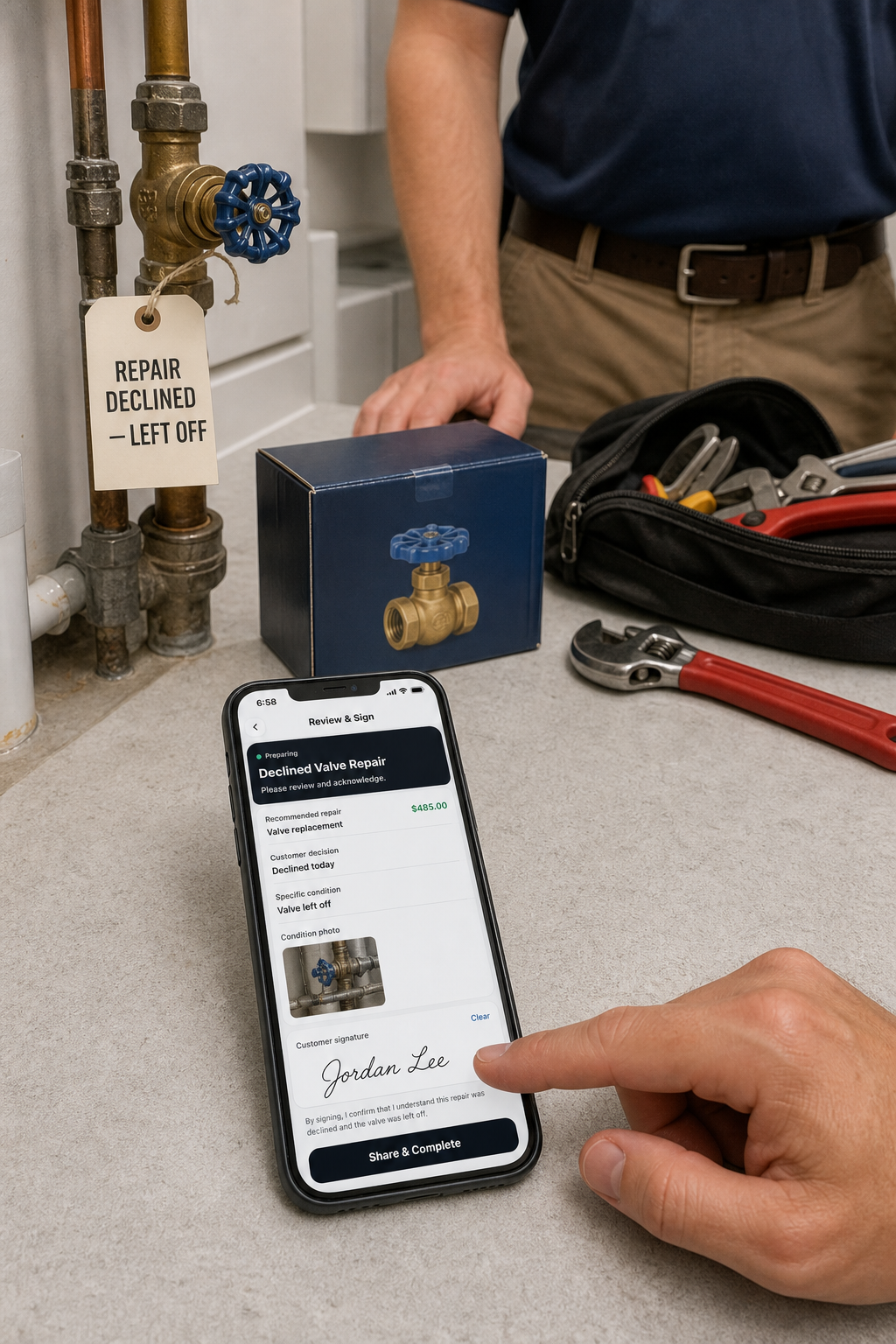
The operating principle
A declined repair is still a precise service decision.
“Customer declined” does not show what was found, whether diagnosis was complete, which option was offered, what the customer understood, or whether any other work was approved. Describe the condition in observable terms, explain the recommended outcome and limits, itemize alternatives, and record each decision separately.
Do not use a signature as a substitute for safety action. A suspected gas leak, carbon-monoxide exposure, energized hazard, flooded electrical equipment, unsafe vehicle condition, structural instability, or recalled product may require isolation, shutdown, evacuation, emergency contact, authority notification, or manufacturer procedures regardless of whether repair is purchased.
Eight-step workflow
Explain, separate, confirm, and close safely.
- 01
Identify the asset and request
Record customer, location, asset/system, model or serial/VIN when relevant, complaint, work order, date, technician, and operating state.
- 02
State what was observed
Use measurements, test results, photos, codes, visible damage, symptoms, and diagnostic limits; distinguish confirmed findings from suspected causes.
- 03
Define the recommendation
Name the exact repair or replacement, parts and labor, intended result, estimate/version, price, timing, warranty, and exclusions.
- 04
Explain urgency accurately
Classify routine, monitor, time-sensitive, do-not-operate, or emergency using qualified judgment and applicable instructions, without exaggerating consequences.
- 05
Offer honest alternatives
Include further diagnosis, temporary stabilization when appropriate, reduced option, replacement, second opinion, defer-and-monitor, or no-service pickup.
- 06
Separate every decision
Mark each item authorized, declined, deferred until a date, or alternative selected; specify exactly what work and charges proceed.
- 07
Set the leaving condition
Record operational, limited use, shut down, isolated, disconnected, reassembled, not reassembled, towed, weather-protected, or removed from service.
- 08
Confirm communication and follow-up
Capture decision-maker, authority, date/time/channel, questions answered, safety instructions, copy delivery, expiration, reminder, and reauthorization path.
Decision matrix
Not every “no” means the same thing.
No corrective work authorized
List the recommendation and price, confirm any diagnostic charge already authorized, state the leaving condition, give safety/use instructions, and provide the estimate copy.
Findings accepted; repair declined
State the diagnostic scope completed, unresolved uncertainty, tests not performed, repair estimate, reassembly status, and whether operation is advised.
Limited action approved
Define exactly what stabilization does and does not accomplish, its price and duration/inspection point, remaining repair, limitations, and stop conditions.
One option approved, another declined
Preserve the compared options and reasons without implying that the customer rejected all service. Carry only the selected option into the work authorization.
Repair postponed until a date
Record the date or trigger, monitoring steps, changing-condition warning signs, estimate expiration, parts availability, and who will initiate follow-up.
No added repair authority
Document attempts and stop at the existing authorization limit. Protect and leave the asset according to the agreement and applicable safety requirements.
Six completed examples
Show the choice and the condition left behind.
Corroded shutoff valve
Valve leaked at stem during operation; replacement recommended for $285. Customer declined replacement and authorized no further manipulation. Valve returned to prior open position, area dry at departure, main shutoff location reviewed. Customer instructed to stop use and close main/call emergency service if active leakage begins.
Combustion safety concern
Furnace produced an abnormal combustion test result; heat-exchanger evaluation and qualified correction recommended. Customer declined repair purchase today. Furnace left off and tagged per company procedure; customer received CO safety instructions and was told suspected exposure requires fresh air and immediate medical/emergency response.
Heat-damaged receptacle
Visible heat damage and loose termination found at kitchen receptacle. Replacement and circuit inspection recommended. Customer approved diagnostic charge but declined repair. Affected circuit left off at identified breaker where authorized; customer instructed not to re-energize or use until evaluated and corrected by a qualified person.
Active flashing leak
Open flashing joint photographed; permanent counterflashing repair recommended for $1,480. Customer declined permanent work and selected $320 temporary weather cover. Cover limits and inspection-after-weather trigger documented; interior damage, concealed conditions, and permanent watertight performance excluded.
Damaged power cord
Cord jacket split with conductors visible. Manufacturer-compatible cord replacement recommended. Customer declined due to parts lead time. Appliance unplugged and marked do not use; no bypass or temporary tape repair performed. Written estimate remains open seven days.
Brake pads below service limit
Measured friction material and rotor condition documented; front brake service recommended under estimate R-204. Customer authorized reassembly and declined repair. Invoice records the decision, communication timestamp, and vehicle return status; shop follows applicable law and policy for unsafe vehicles rather than relying on a waiver.
Reusable field sheet
Declined repair acknowledgment
Document the decision; do not draft a blanket release.
Create a repair decision with JobSign →- Customer and authority
- [Customer/agent, contact, authority basis, asset owner, decision-maker different from payer]
- Asset and request
- [Location, system/asset, model/serial/VIN, complaint, work order, date, technician]
- Observed condition
- [Measurements, tests, codes, symptoms, visible damage, photos; confirmed versus suspected]
- Diagnostic limits
- [Access/tests completed, not tested, teardown/reassembly, hidden conditions, qualified follow-up]
- Recommended repair
- [Exact scope, parts/labor, intended result, estimate/version, price, time, warranty, exclusions]
- Urgency and safety
- [Routine/monitor/time-sensitive/do-not-operate/emergency; basis, immediate instructions, escalation]
- Alternatives explained
- [Further diagnosis, stabilization, reduced option, replacement, second opinion, defer/monitor]
- Itemized decisions
- [Each item: authorized, declined, deferred to date/trigger, or alternative selected]
- Work proceeding
- [Exact authorized work/charge and stop point; what will not be performed]
- Leaving condition
- [Operational/limited/off/isolated/disconnected/reassembled/towed/protected; keys/parts returned]
- Communication
- [Questions answered, instructions delivered, language/accessibility, date/time/channel, contacts]
- Follow-up and copy
- [Estimate expiration, monitoring trigger, reminder, reauthorization route, attachments, copy delivered]
A signature documents communication and choice; it does not erase duties imposed by law, code, license, warranty, manufacturer instructions, emergency procedure, or the agreement. Use qualified judgment and jurisdiction-specific review.
Research basis
Specific authorization and clear safety direction matter.
California BAR’s January 2026 automotive guidance is a useful regulated-industry example: authorization is tied to a specific job; written, oral, or electronic decisions are documented; related communications remain linked to the transaction; signed copies are provided; and declined repair or reassembly after teardown is recorded on the invoice.
FTC guidance recommends explaining why service is recommended and keeping dated transaction records. EPA and CPSC safety guidance shows why a decline form cannot replace urgent action: suspected CO exposure calls for fresh air and medical attention; hazardous fuel-burning or electrical equipment may need to remain off until qualified inspection.
- California BAR: documentation and repair authorization ↗
- FTC: explain recommendations and document transactions ↗
- EPA: carbon-monoxide response and qualified inspection ↗
- CPSC: gas and flooded-electrical emergency precautions ↗
Documentation guidance only, not legal, engineering, safety, code, medical, or trade advice. Follow actual emergency procedures and jurisdictional requirements.
Declined repair questions
What belongs in the acknowledgment?
Condition, diagnostic limits, recommendation, estimate, alternatives, urgency, safety direction, itemized decisions, proceeding work, leaving condition, communication, follow-up, and copy.
Is this a liability waiver?
No. It should document communication and choice. Obtain jurisdiction-specific advice before adding any release language.
What if there is an immediate hazard?
Follow emergency, utility, code, manufacturer, licensing, and company procedures. A signature is not permission to ignore imminent danger.
Can some repairs be approved and others declined?
Yes. Record each item separately and carry only the authorized items into the work order.
A clear record of “not today”
Preserve the recommendation, the choice, and the safe leaving condition.
JobSign helps repair professionals document customer decisions and deliver a signed PDF copy.
Explore repair approvals →