
Trade guide · Drywall repair
Measure the patch. Define the finish. Assign the paint.
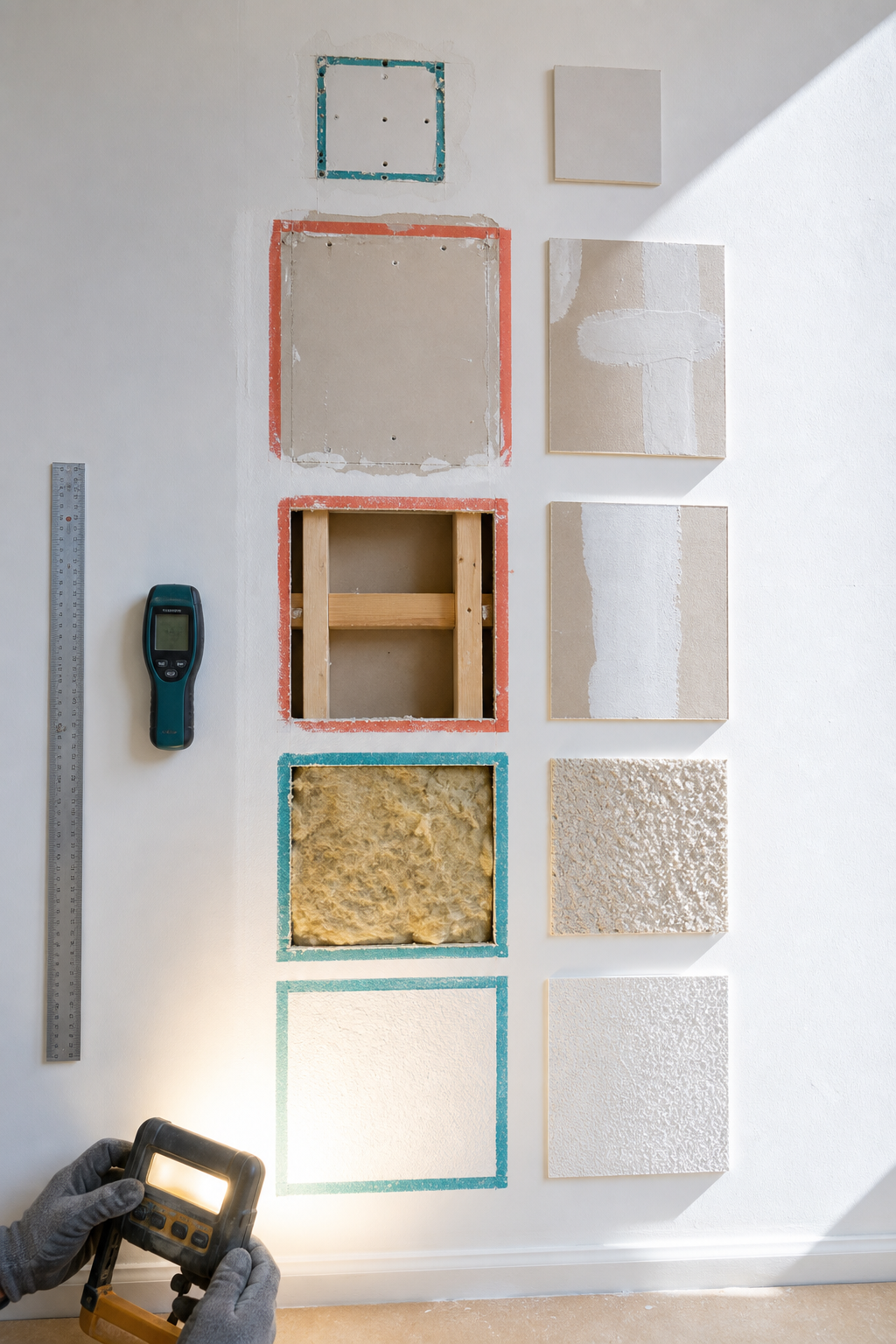
Use five filled examples for additional access patches, water-damaged board, texture changes, framing corrections, insulation, drying, and finish boundaries.
The scope rule
A patch is not complete until the finish boundary is named.
Count openings and measure repaired area, but also state backing, board type/thickness, joint treatment, finish level, texture sample, blend boundary, primer and paint responsibility, drying, return visits, protection, and acceptance conditions.
Localized matching is not automatically invisible. Existing texture, coatings, light, repairs, and substrate affect appearance. Offer a defined localized blend and, when appropriate, a separately priced full-wall or ceiling finish option.
Five measurable examples
Turn the opened wall into an exact customer decision.
Access holes from plumbing or electrical work
Baseline: two patches up to 12 by 12 inches, Level [___] finish, paint excluded. Change: add six labeled openings totaling 18 square feet; install backing where listed, compatible board, tape and compound, sand, and feather to marked boundaries. Includes three visits for application/drying. Excludes insulation, fire/sound assembly restoration not listed, texture, primer/paint, hazardous material, moisture, and openings enlarged after measurement. Adds $1,260 and two working days.
Water-damaged board extends beyond visible stain
Discovery: softened/swollen board extends beyond original 3-by-4-foot allowance to marked area W-01; moisture/source status documented. Authorize: remove only within approved boundary, inspect accessible cavity, replace suitable board after customer/qualified party confirms source correction and drying condition, and finish within $2,400 NTE. Notify at 70%. Stop for ongoing moisture, mold-like growth, contaminated water, damaged framing, suspect regulated material, affected HVAC, or more than 40 square feet. Remediation, source repair, insulation, paint, and contents are excluded.
Texture match versus full-wall refinish
Condition: existing orange-peel/knockdown/hand texture varies across wall and prior repairs are visible under side light. Option A $780: localized sample T-02 and blend within marked 6-by-8-foot zone; exact invisibility not promised. Option B $1,640: prepare and retexture the full wall plane from corner to corner for a more uniform field. Both exclude primer/paint unless listed, adjacent walls/ceiling, furniture movement, coating failure, and color/sheen match. Customer approves physical sample and viewing condition before production.
Missing backing or framing correction
Finding: opening edges do not have suitable attachment at locations B-01/B-02; existing framing condition differs from scope assumption. Authorize: limited nonstructural backing/blocking within accessible cavity, labor $[___]/hour and materials at [basis], then listed drywall repair within $1,800 NTE. Stop for structural members, plumbing/electrical conflicts, rated assembly design, rot/insects, hazardous material, or opening expansion beyond [dimensions]. Structural work, engineering, other trades, insulation, paint, and source correction excluded.
Insulation and finish scope added after opening
Baseline: drywall closure only; insulation replacement excluded. Change: replace the specifically removed insulation area with verified project-compatible material after cavity is approved for closure, then close 24 square feet with listed board, finish to agreed level, and match sample T-04 within the defined zone. Includes protection, cleanup, and two added return visits for drying. Excludes whole-bay energy upgrade, vapor/air-barrier redesign, wet/contaminated insulation, mold/asbestos/lead work, framing repair, permit/design, primer, and paint.
Reusable field sheet
Drywall repair change
Use a patch register and approved texture sample as attachments.
Create a drywall change order with JobSign →- Original baseline
- [Patch count/size, board, backing, finish level, texture, protection, visits, primer/paint, restoration exclusions]
- Added locations and quantity
- [Room/wall/ceiling IDs, dimensions, total area, opening/patch register, photo references]
- Assembly and finish
- [Backing, board type/thickness/layers, joint treatment, finish level, texture/sample, blend/full-plane boundary]
- Moisture and closure
- [Source status, drying/assessment owner, closure prerequisite, moisture evidence, return visits]
- Price and time
- [Fixed/unit/T&M/NTE, rates, materials, protection, disposal, visits, tax/markup, added days, payment]
- Stop conditions
- [Ongoing/contaminated water, mold-like condition, suspect asbestos/lead, structural damage, other trade, rated assembly, expanded area]
- Paint and exclusions
- [Primer/paint responsibility, color/sheen, adjacent planes, exact-match limitation, contents, remediation, source repair]
- Approval
- [Selected option, revised total, signatures/authority/timestamps, completed copy]
Verify assembly requirements, manufacturer guidance, adopted code, moisture, regulated materials, qualified assessment, contract, and jurisdiction. This form is not a hazardous-material or remediation plan.
Research basis
Finish expectations and hazard stops must be explicit.
The Gypsum Association’s GA-214 framework describes finish levels before final decoration and notes that appropriate finish depends on decoration, location, and illumination. Use the current project specification and manufacturer literature for the actual assembly.
EPA says suspect drywall or related material cannot be identified as asbestos-containing by sight and recommends properly trained, accredited professionals for assessment/sampling before disturbance. EPA also emphasizes moisture-source assessment and qualified help for larger, contaminated, complex, or mold-affected water damage.
- Gypsum Association: levels of gypsum board finish ↗
- EPA: drywall and asbestos assessment ↗
- EPA: renovation and suspect asbestos materials ↗
- EPA: mold and qualified assessment ↗
Documentation guidance only, not drywall, remediation, hazardous-material, safety, code, or legal advice.
Drywall change order questions
What belongs in a drywall change order?
Locations, dimensions, assembly, finish/texture, drying, visits, paint, price, time, exclusions, stop conditions, and approval.
Can texture matching be guaranteed?
Define a sample, blend boundary, viewing condition, and full-plane option rather than promising an invisible localized match.
What if water damage expands?
Stop, document moisture and materials, confirm source/drying, and obtain qualified assessment when conditions exceed the repair boundary.
What if asbestos is suspected?
Do not identify it by sight or disturb it casually; use properly trained and accredited assessment/testing professionals as applicable.
A measurable finish decision
Approve the patch, texture, visits, paint boundary, and stop point.
JobSign helps contractors attach photos and samples, price added repair, collect signatures, and share the completed PDF.
Explore change order approvals →