
Auto service guide · Diagnosis and repair
Authorize the specific job before the wrench turns.
Connect customer and vehicle identity, complaint, diagnosis, exact parts and labor, price limit, teardown, test drive, added-work stop, storage, declined items, and final invoice without claiming one form satisfies every state.
The operating principle
Authorize diagnosis, repair, and added work as separate gates.
A complaint is not a diagnosis, a drop-off is not necessarily repair authorization, and approval to inspect is not permission to install parts. Freeze the customer request and vehicle condition, define the diagnostic job and limit, report findings, then obtain the specific repair authorization required by the state before work or added charges proceed.
State rules are not interchangeable. California, New York, and Florida differ in estimate triggers, required disclosures, parts treatment, authorization records, storage, and invoice details. Use this as a workflow checklist, then adapt the actual document to the shop’s jurisdiction, registration, repair type, and state-required language.
Nine-step repair workflow
Keep each customer decision attached to one transaction.
- 01
Identify customer, provider, and vehicle
Record legal business/registration data, mobile service location, customer/contact/authority, year/make/model, VIN, plate, odometer, fuel/charge, keys, and visible condition.
- 02
Capture complaint in customer language
Note symptoms, warning lights, noises, timing, operating conditions, prior repair, tow/drop-off, and the exact service or result requested.
- 03
Authorize diagnosis first
Define inspection/tests/scan/disassembly, diagnostic fee or NTE, time, road test, consumables, access, what is not included, and the stop before repair.
- 04
Report findings and confidence
Show measurements, codes, photos, confirmed failure, suspected cause, safety status, diagnostic limits, and further testing needed.
- 05
Prepare the specific repair estimate
Itemize understandable labor operations, each part and classification, quantity/price, sublet, disposal/fees, tax treatment, total, warranty, timing, and exclusions.
- 06
Handle teardown separately
State area/component, teardown and reassembly cost/time, normally destroyed parts, prior-condition limitation, findings deliverable, and next repair-or-reassemble decision.
- 07
Obtain and preserve authorization
Capture exact job/version/amount, written/oral/electronic method as allowed, approver, date/time/channel, designated person, signature, and customer copy.
- 08
Stop for additional repairs
Issue the revised parts/labor and total, explain impact, obtain added authorization, and link messages to the same repair order before additional cost accrues.
- 09
Close with invoice and vehicle status
List work performed and parts supplied, declined items, replaced-parts disposition, warranty, final total/payment, storage/pickup notices, road-test result, and copies.
Three authorization gates
One “go ahead” should not unlock everything.
Find the cause under a known limit.
Approve scan/testing/inspection or named teardown, fee/NTE, road test, time, and stop. No replacement parts or corrective repair unless specifically listed.
Choose from findings and an itemized estimate.
State exact operation, parts type, total, completion estimate, warranty and exclusions. If teardown occurred, include the option and cost/time to reassemble where required.
Revise before scope or cost grows.
Provide added parts/labor, amount, revised total and schedule, then capture the customer’s decision and authorization details under state rules.
Show what actually happened.
Reconcile authorized versions to performed operations, parts supplied, no-charge/warranty work, tax/fees, declined recommendations, final status, payment and copy.
Two completed examples
Adapt the same decision chain to bay and roadside work.
Diagnosis capped before parts
2017 compact SUV, VIN/plate/odometer photographed, customer reports crank/no-start after overnight parking. Authorize mobile arrival plus up to 1.0 diagnostic hour, battery/load/charging checks, scan and accessible fuel/spark checks, NTE $265. Includes one safe stationary test; excludes tow, invasive fuel-pressure access, teardown and parts. Finding: failed battery plus charging system passes. Revised repair option lists specified new battery, core treatment, labor, tax, mobile location, $438 total, and new electronic authorization.
Measured repair with an added-work stop
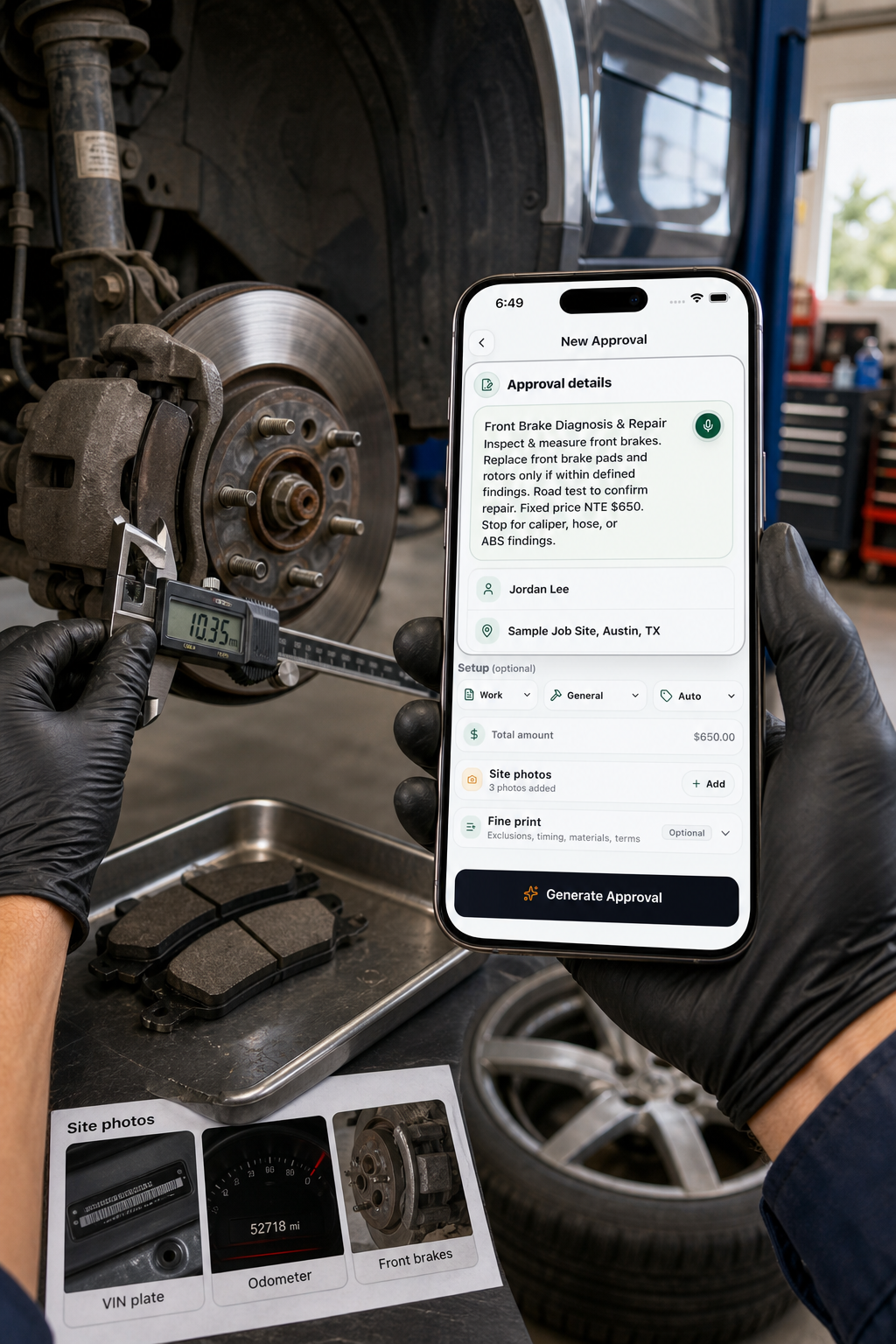
Customer complaint: grinding at low speed. Inspection authorization $95, credited if repair selected. Photos and measurements show inner pads below service limit and rotors outside shop’s published reuse criterion; calipers move normally, hoses visually intact. Repair estimate: new specified front pad set and two rotors, clean/lubricate listed contact points, torque wheels, controlled road test, $650 total before applicable tax. Stop for caliper, hose, hub, ABS, or rear-brake findings. Customer requests replaced parts where state process allows and receives estimate copy.
Reusable field sheet
Auto repair authorization
Adapt every field and disclosure to the repair jurisdiction.
Create an auto repair approval with JobSign →- Provider and customer
- [Business/registration/address/phone, mobile repair location, customer/contact, owner/authorized person]
- Vehicle intake
- [Year/make/model/trim, VIN, plate/state, odometer, fuel/charge, keys, tow/drop-off, visible condition/photos]
- Complaint/request
- [Customer’s words, symptoms/lights/noise, timing/conditions, prior work, requested diagnosis/service]
- Diagnostic authorization
- [Tests/scan/inspection/disassembly/road test, fee or NTE, time, consumables, limits, stop before repair]
- Findings and safety status
- [Measurements/codes/photos, confirmed/suspected cause, uncertainty, safe/limited/do-not-drive/tow guidance]
- Repair operations
- [Specific understandable labor tasks, sublet, testing, road test, completion estimate, exclusions]
- Parts and charges
- [Each part, new/used/rebuilt/reconditioned/OEM/non-OEM as applicable, quantity/price, core, supplies, fees/tax]
- Teardown/reassembly
- [Area/component, teardown cost, reassembly cost/time, destroyed seals/parts, restoration limitation, next decision]
- Replaced parts and warranty
- [Return/inspect request and timing, exchange/warranty exceptions, parts/labor provider/term/conditions]
- Additional-work contact
- [Who may authorize, phone/email, revised-work requirement, warning threshold, hard stop, no-response handling]
- Storage, pickup, and payment
- [Completion notice, pickup deadline, storage disclosure/rate/start as lawful, payment, lien process not assumed]
- Authorization and closeout
- [Exact version/amount, method, name/date/time/channel/signature, declined work, invoice, copies, retention ID]
This is not a nationwide-compliance form. Automotive estimate, authorization, teardown, parts, fee, storage, invoice, record-retention, mobile-repair, lien, and disclosure rules vary by state and repair type. Use the regulator’s current requirements for the job location.
Jurisdiction-labeled research
The workflow travels; the required form does not.
California: BAR’s January 2026 guide requires specific-job estimates and authorization, identifies part classifications, adds detailed teardown/reassembly requirements, and requires revised authorization before additional repair or cost. Mobile repair invoices include the service location.
New York: DMV says shops need customer authorization, telephone authorization records include date/time/person, estimates and invoices identify specific parts/labor, and storage notice rules apply. Florida: the statute uses its own written-estimate threshold and required disclosures. These examples show why one generic national claim would be misleading.
- California BAR: 2026 documentation and authorization guide ↗
- New York DMV: estimates, authorization, parts, invoice ↗
- New York DMV: current repair-shop regulations ↗
- Florida Statutes: motor-vehicle repair provisions ↗
- FTC: consumer auto-repair estimate guidance ↗
Documentation guidance only, not automotive, safety, consumer-protection, storage, lien, tax, licensing, or legal advice. Verify current state and local requirements.
Auto repair authorization questions
What belongs in the form?
Provider/customer, vehicle, complaint, diagnosis, findings, repair, parts/fees, teardown, replaced parts/warranty, added work, storage/pickup, authorization, declined work, and invoice.
Is a drop-off note or text enough?
Rules vary. California says an after-hours note alone is not authorization. Follow the jurisdiction’s required information, method, and timing.
What belongs in teardown authorization?
Area/component, teardown and reassembly cost/time, destroyed seals/parts, prior-condition limitation, findings deliverable, and next decision.
Can the estimate be exceeded?
Do not exceed authorized work or limits without the additional authorization required by the applicable state and a documented revised total.
One specific repair decision
Use JobSign to turn findings into a customer-ready auto approval.
Describe the work, select Auto, add the amount, photos and fine print, collect authorization, and share the signed PDF.
Explore repair approvals →