
Field-decision guide · Access delays
Document the workface you had, not the jobsite you expected.
Create a same-day record of promised and actual access, affected work, people and equipment on site, mitigation, requested action, and possible schedule or cost follow-up.
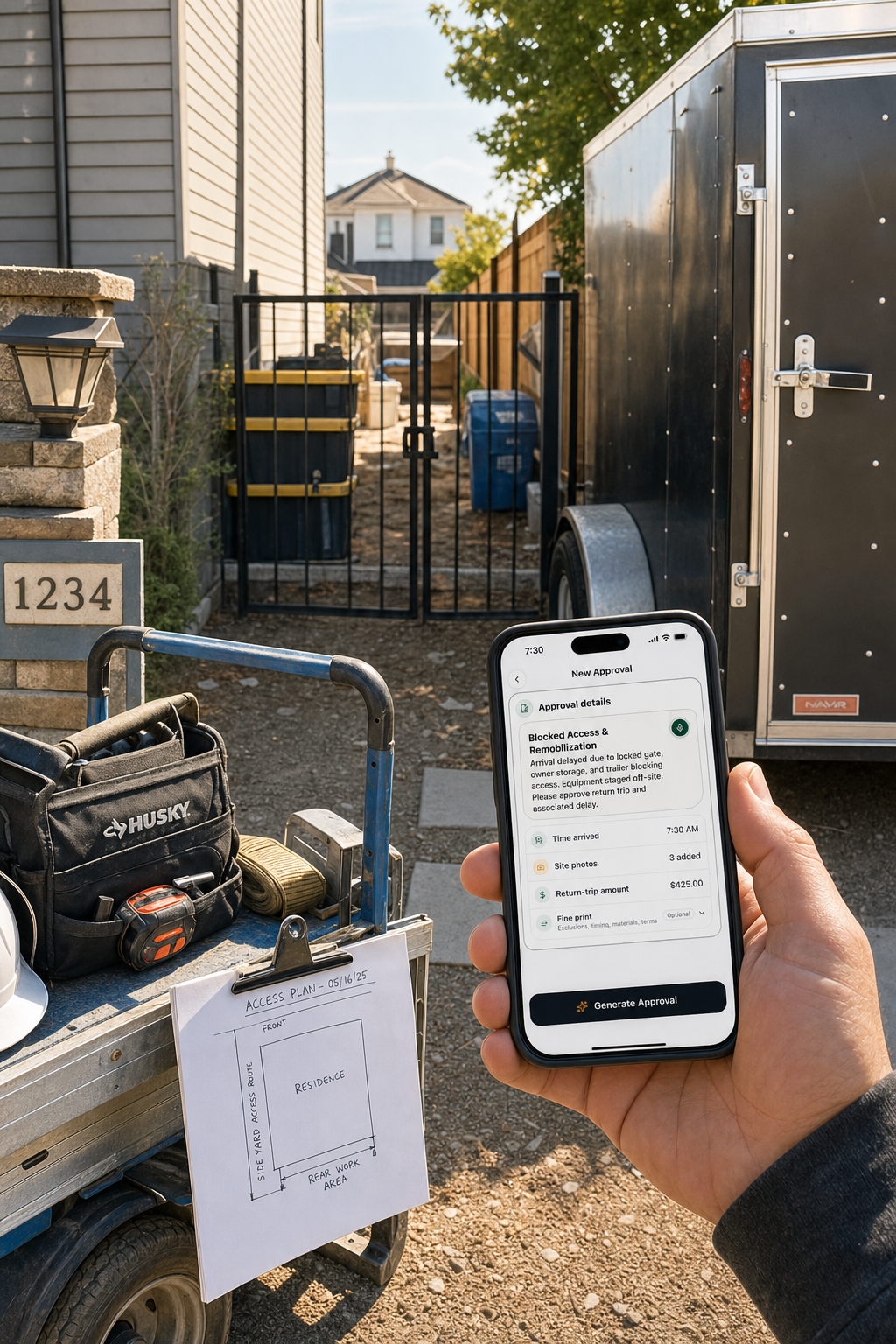
The operating principle
Describe access by location, time, and task.
“No access” is often too broad. A building may open late, one occupied room may remain closed, or the crew may reach the floor but not the electrical room. Record what was promised, what was actually available, when it changed, and which exact activities were affected.
Separate observation from responsibility and a potential effect from a final claim. This field record supports the contract notice process; it does not establish liability, prove critical-path delay, or automatically authorize added cost.
Eight-step workflow
Preserve the event while there is still time to recover.
- 01
Freeze the access baseline
Cite the contract, work order, schedule, email, or meeting note defining date, window, route, area, escort, shutdown, and readiness.
- 02
Time-stamp actual access
Log arrival, gate entry, escort arrival, area release, restriction changes, departure, and material contact attempts.
- 03
Map access by workface
Identify building, floor, room, system, delivery route, utility, and whether each was open, partial, blocked, or unsafe.
- 04
Connect access to planned tasks
List the operation, predecessor, crew, equipment, material, planned quantity, and task that could or could not proceed.
- 05
Record what still happened
Capture completed quantity, alternate work, protection, handling, cleanup, standby, and productive periods.
- 06
Attempt reasonable mitigation
Ask for another route or area, resequence compatible work, adjust crew where practical, and record why unsafe work was declined.
- 07
Request a specific cure
Name the access or decision needed, contact, readiness evidence, deadline, proposed window, and next step if unresolved.
- 08
Deliver and follow the contract
Send the field record, preserve delivery, then issue any separate contractual notice, schedule update, or change request on time.
Fact versus conclusion
Write what the record can support today.
“The owner delayed the whole job.”
Write: “Rooms 204–208 were due for release at 7:00. At 7:35, rooms 204–206 remained occupied and 207–208 were available. Work proceeded only in 207–208.”
“Our crew lost eight hours.”
Write: “Four installers were present 6:55–1:30. Alternate work produced 96 linear feet from 8:10–11:20. The crew protected material and departed after no additional area was released.”
“This adds three days.”
Write: “The blocked task precedes cabinet template and fabrication. We request release by July 16 and will update completion effect after access is confirmed.”
“We did everything possible.”
Write: “Requested an escort twice, proposed the west entrance, moved one cart through the service route, completed staging, and declined occupied-room work to avoid damage.”
Four completed examples
Match the notice to the access problem.
Keyholder unavailable
Baseline: 8:00 entry confirmed. Actual: crew arrived 7:53; code failed; three calls; entry at 9:06. Effect: demolition started 66 minutes late and haul-off was missed. Request: confirm a new slot and code by 4:00.
Three of five rooms occupied
Actual: rooms 207–208 clear; 204–206 contained furniture and occupants. Mitigation: completed prep in released rooms. Request: clear remaining rooms and send release photos before return scheduling.
Noise window shortened
Baseline: drilling approved 9:00–2:00. Actual: noise stopped 10:20–1:15 for a meeting. Work: shifted to layout; 18 of 42 anchors installed. Request: approve a protected four-hour window.
Ceiling not released
Actual: above-ceiling inspection remained open and grid incomplete. Mitigation: installed trims in released offices. Request: confirm inspection pass, completed grid, and corridor release.
Reusable one-page record
Jobsite access delay
Send it the same day, then follow every contract notice requirement.
Create a field authorization with JobSign →- Project and record
- [Project/address, agreement, notice number, author, date/time/time zone]
- Scheduled access baseline
- [Window, route, work area, escort/key, shutdown, parking/laydown, source/version]
- Planned operation
- [Task/location, predecessor, crew/equipment/material, quantity/duration, successor]
- Actual access timeline
- [Arrival, entry, area release, restriction changes, departure, named contacts]
- Access map
- [Open/partial/blocked/unsafe by room, system, route, utility, delivery and laydown]
- Observed condition
- [Objective facts: occupants, contents, lock/escort, incomplete work, safety condition]
- Work and resources
- [Crew/equipment, work completed, standby, material handled/protected, third parties]
- Affected tasks
- [Unable/reduced operation, location/quantity, predecessor/successor or milestone]
- Mitigation attempted
- [Alternate route/area/task, resequence, crew adjustment, contacts, result]
- Requested resolution
- [Exact access/decision, contact, readiness evidence, deadline, recovery window]
- Potential follow-up
- [Schedule update, return visit, time/cost review, change request, separate notice]
- Attachments and delivery
- [Photos/map/schedule/messages/log; recipients, method, sent/received timestamps]
This record preserves contemporaneous facts; it does not determine fault, critical-path effect, entitlement, damages, or a time extension. Review the agreement and law for notice requirements.
Research basis
Daily facts and timely notice are different jobs.
Caltrans’ construction manual provides a detailed public-works example: daily records capture work location, operation, progress, weather, named discussions, objections, and significant facts. Its dispute process separately emphasizes written delivery, receipt time, completeness, and contractual timeliness.
A federal COR guide illustrates the later analysis: review clauses and schedule modifications, correspondence, notices, supporting documents, and claimed cause before classifying delay. These are research examples, not universal private-project rules.
- Caltrans: daily reports and contemporaneous facts ↗
- Caltrans: written notice and potential claim records ↗
- Federal COR guide: schedule, notices, and delay support ↗
- Oregon CCB: schedule-delay conditions ↗
Documentation guidance only, not scheduling, claims, contract, or legal advice. Requirements vary by agreement and jurisdiction.
Jobsite access delay questions
What belongs in an access delay notice?
Scheduled access, actual timeline and locations, contacts, condition, planned and completed work, affected tasks, resources, mitigation, requested cure, attachments, and delivery.
When should the record be sent?
Create and send it the same day when practical, while meeting contract recipient, content, method, and deadline requirements.
Does the notice prove a time or cost claim?
No. It preserves facts and notice. Entitlement requires the contract, schedule, causation, mitigation, law, and support.
How is this different from a return trip authorization?
The access record documents the event. A return authorization defines the future visit, charge, scope, and readiness.
One same-day field record
Map the unavailable area, preserve the effect, and request the cure.
JobSign turns field facts and a requested decision into a shareable signed PDF.
Explore work authorizations →