
Recovery guide · Late documentation
Reconstruct what happened without rewriting when approval happened.
Preserve original evidence, disclose that the record is being created after completion, separate acknowledgment from advance authorization, resolve disputed facts honestly, and repair the workflow for next time.
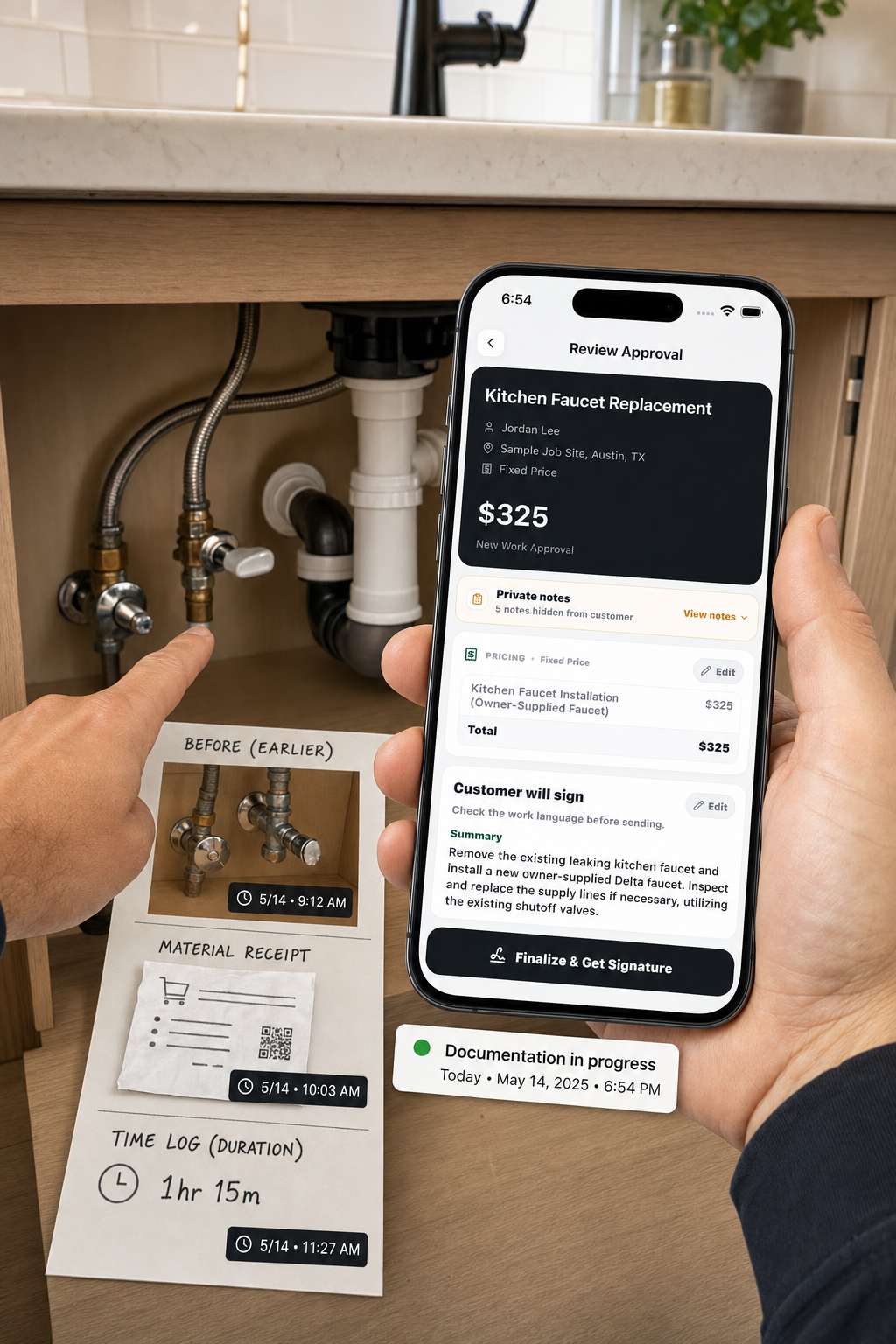
The operating principle
A late record can clarify history; it cannot change history.
Start by stating the truth: “This record was prepared on [today] concerning work performed on [earlier dates].” Preserve the original contract baseline and source files. Do not alter timestamps, recreate a missing signature, convert an ambiguous conversation into a definite approval, or label disputed facts as agreed.
Then identify the document’s present purpose. It may ask the customer to acknowledge chronology, approve a current price/payment resolution, confirm only undisputed quantities, or state a disagreement for the contract’s dispute process. Those are different acts from authorization obtained before work.
Eight-step recovery workflow
Rebuild the file from contemporaneous sources outward.
- 01
Stop editing the originals
Preserve messages, email, call logs, photo/video files and metadata, daily logs, timecards, receipts, deliveries, directives, plans, inspections, and invoices.
- 02
Freeze the contract baseline
Cite the signed scope, drawings, exclusions, allowances, pricing method, change clause, authority, notice requirements, schedule, and prior approved changes.
- 03
Build a source-linked timeline
For each event, record actual date/time, person, communication or observation, request/direction, work, quantity, and direct source—without filling gaps by assumption.
- 04
Define the actual delta
Separate original work, changed/deleted work, added work, rework, contractor correction, emergency stabilization, and disputed classification by location and quantity.
- 05
Reconcile price and schedule
Show labor, material, equipment, subcontract, fee, markup/tax, credits, payment already made, net request, actual dates, and claimed effect separately.
- 06
Label authority and approval accurately
Identify who requested or observed the work, their verified authority, what evidence exists, and whether prior authorization is confirmed, unclear, absent, or disputed.
- 07
Ask for a present decision
Offer acknowledge facts, agree current amount/payment, accept part and dispute part, request support, or decline/dispute—each signed and dated today.
- 08
Follow the agreement and prevent recurrence
Use notice, negotiation, claim, mediation, lien, or dispute procedures as applicable, then add a field stop before any future changed work is released.
Choose the right current record
Do not call every late document a change order.
What happened, when, and according to which source?
A contractor-prepared record can organize evidence without claiming customer agreement. Label inferences, missing evidence, conflicting accounts, and the preparer/date.
Which facts does the customer confirm today?
The customer may acknowledge that a request was made, materials were selected, work was observed, or quantities were completed while expressly not agreeing to price, liability, or prior authorization.
What amount and terms are the parties agreeing to now?
If permitted and mutually accepted, state today’s agreement, consideration/payment schedule, reservation or release terms only if intentionally reviewed, and no representation that it was signed earlier.
What is agreed, what is disputed, and what happens next?
Preserve contractor and customer positions, undisputed payment, evidence requests, response deadline, and contract process without coercion or a false “approval” label.
Non-backdated example
A current acknowledgment of an earlier plumbing change.
Prepared May 18 · work May 14
“This document was prepared May 18, 2026, after the work described below was performed May 14, 2026. It does not state that a written change order was signed before work.” Original contract V2, text thread export, four original photos, supplier receipt, and technician time log are attached.
Discovery, call, message, work
9:12 photo shows seized shutoff during contracted faucet replacement. Technician called customer 9:18; call lasted 3 minutes, content not recorded. At 9:27 customer texted, “Replace them if that’s what it takes to finish today.” No price appears in the thread. Two valves and supply lines installed 9:42–11:27; completion photo 11:31.
$410 supported · prior price approval unconfirmed
Added labor 1.75 hours at disclosed $140/hour = $245; two valves/lines receipt $96; contract markup $19; tax $0; net current request $360. The calculation is shown separately from the original faucet allowance, and no amount is labeled previously approved.
Facts acknowledged; amount disputed
Customer confirms requesting completion and that two valves/lines were installed, but does not acknowledge receiving or approving price before work. Customer offers $250; contractor maintains $360 request. Both positions, attachments, current signatures, and next discussion date are preserved without changing the May 14 record.
Timeline reconstruction worksheet
Late change record
Use actual dates. Never backdate the record or signature.
Build the next approval before work →- Present purpose
- [Chronology only / factual acknowledgment / current payment agreement / disputed-change record]
- Timing disclosure
- [Actual preparation/signature date; actual work dates; explicit statement that record is after performance]
- Contract baseline
- [Agreement/version, original scope/exclusions, drawings, pricing/change/notice/authority clauses, prior changes]
- Original evidence index
- [Messages/email/calls, photos/video + metadata, logs/timecards, receipts/deliveries, directives, witnesses]
- Source-linked chronology
- [Date/time, person, event/request, exact words or neutral summary, work/quantity, source ID; gaps/conflicts]
- Scope reconciliation
- [Original, deleted, added, rework/correction, emergency work, location, measured quantity, completed status]
- Authority and prior approval
- [Requester/observer, authority source/limit, prior authorization: confirmed/unclear/absent/disputed, evidence]
- Price reconciliation
- [Labor/material/equipment/subcontract/fees/markup/tax, credits/payments, arithmetic, net current request]
- Schedule record
- [Actual dates and contemporaneous schedule records; claimed impact clearly separate from agreed impact]
- Customer response today
- [Acknowledge facts / agree amount and terms / accept part / request support / dispute; exact boundaries]
- Positions and next process
- [Each party’s position, undisputed payment, response date, negotiation/claim/mediation/lien/dispute path]
- Current signatures and copy
- [Authority, signatures/authentication and today’s timestamps, attachments, copy delivered; no backdating]
Do not use this worksheet to fabricate prior authorization, alter source evidence, or mislabel disputed facts. Late documentation may not cure noncompliance or create entitlement. Review the actual contract, law, deadlines, and available remedies with qualified counsel where material.
Research basis
Preapproval rules make honest timing essential.
California CSLB provides a strict state-specific example: covered home-improvement price or scope changes must be written and signed before changed work begins. Oregon CCB’s sample likewise states that extra-cost alterations are performed only after the parties enter a written change order. A late record should not imply compliance with advance requirements when none occurred.
Federal ratification rules are not private-construction law, but they illustrate the conceptual separation: an unauthorized commitment is not automatically binding, ratification is a later act by an official with authority, detailed evidence is reviewed, and the process must not encourage unauthorized commitments. Use the actual private or public contract and jurisdiction.
- California CSLB: written change before work ↗
- California CSLB: contractor change-order guide ↗
- Oregon CCB: sample advance change order ↗
- FAR: ratification of unauthorized commitments ↗
- Army FAR supplement: evidence and review example ↗
Documentation guidance only, not contract, claim, lien, collection, evidentiary, or legal advice. Deadlines and remedies vary materially by agreement and jurisdiction.
Late change-order questions
Can a change order be signed after completion?
A current document can record facts or a present agreement, but it is not advance authorization and must never be backdated.
What evidence should be preserved?
Original messages, calls, photos/video and metadata, logs, time, receipts, deliveries, plans, directives, inspections, witnesses, and the contract baseline.
What if the customer disputes it?
Separate agreed and disputed facts and amounts, preserve both positions, provide support, and follow the contract’s dispute process.
How do we prevent this next time?
Stop when scope changes, document and price the delta, verify the approver, collect required written approval, deliver a copy, then release work.
The next change starts earlier
Use JobSign before changed work leaves the decision point.
Create the scope and price, review the customer-facing language, collect approval, and deliver the signed PDF before work proceeds.
Explore sign-off before work →