
Home-service guide · Appliance repair
Diagnose the appliance first, then authorize the part and return.
Connect the model and symptom to a written diagnostic fee, access limits, findings, recall/warranty status, repair option, parts terms, return visit, price cap, qualification boundary, and customer decision.
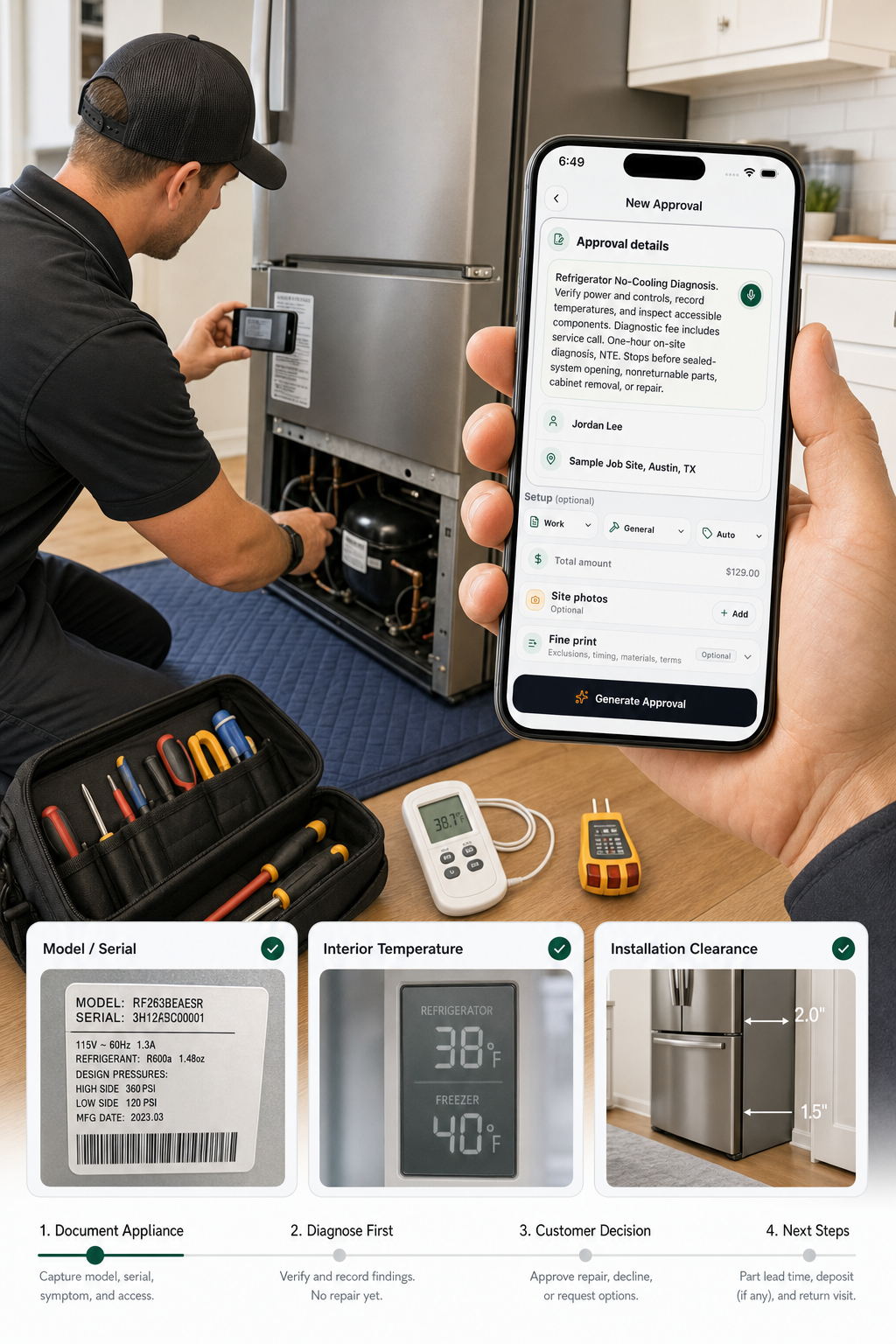
The operating principle
A service call can end with findings, not a repair.
Record the appliance before diagnosis: exact model/serial/date code, installation and access, symptom in the customer’s words, error display, operating state, prior repairs, warranty/service contract, and recall check where appropriate. Then define what the diagnostic charge buys and where the technician must stop.
After findings, distinguish a confirmed failure from a probable part. Price the part, deposit, shipping, returnability, first-visit and return labor, testing, access/reinstallation, and unresolved conditions. If another finding could materially change the repair, use a cap or second diagnostic gate rather than promising that one ordered part will solve it.
Four-gate workflow
Keep the appliance decision moving without skipping consent.
- 01
Document appliance and symptom
Capture provider/customer, location, type/brand/model/serial/date code, installation photos, symptom, error, operating state, prior work, and authority.
- 02
Authorize diagnosis first
State service call, travel, inspection/tests, safe access/disassembly, diagnostic fee or NTE, estimated time, reassembly, exclusions, and no-repair stop.
- 03
Report findings and options
Show measurements/codes/photos, confidence, recall/warranty/service-contract result, safety/leaving status, exact repair or further diagnosis, and replace/decline option.
- 04
Authorize part, labor, and return
List part/ordering basis, price/deposit/returnability/lead time, labor and return trip, tax/shipping, total/NTE, warranty, change trigger, and signature.
Decision controls
Make the expensive surprises visible before ordering.
What does the first visit include?
State travel/service call, time or tests, accessible disassembly, whether fee credits toward repair, and charges if the customer declines or the unit is inaccessible.
What exactly is the customer funding?
Identify part or ordering basis, deposit, shipping/tax, nonreturnable or restocking condition, lead-time estimate, substitutions, cancellation, and ownership of the ordered part.
Which labor is included when the part arrives?
Define scheduling trigger, access, removal/reinstallation, installation labor, ordinary testing, additional trip, helper/lift needs, and what causes revised scope.
Can the appliance be used between visits?
Record operating, limited use, unplugged, utility isolated, reassembled, not reassembled, moved or left in place, contents/customer action, and safety escalation.
Four completed examples
Change the gate to match the appliance.
$129 diagnosis before sealed-system work
Model/serial and compartment temperatures photographed. Service call includes power/control verification, accessible visual inspection and up to one hour; excludes opening refrigerant circuit, cabinet removal and repair. Findings suggest control fault but compressor response must be verified. Customer chooses $245 further diagnostic option under a stop limit rather than ordering a nonreturnable board immediately. Appliance left powered only if technician’s qualified safety assessment allows; food safety is customer-managed.
Pump replacement with access assumption
Diagnosis confirms powered pump but no flow and accessible trap clear. Repair option: specified drain pump $168, labor/return $225, shipping $24, tax as applicable, $200 parts deposit, estimated 4–7 business days. Assumes ordinary laundry-room access and movable machine; stacked-unit separation, damaged hose, drain blockage, control fault, floor repair and helper are excluded and trigger new approval.
Recall and gas/electrical stop before ordinary repair
Technician records model/serial/date code and checks official recall/manufacturer channel. If affected, follow the recall remedy and stop-use direction rather than selling substitute work. If not affected, authorize qualified diagnosis of controls/sensor and visible connections under $195; gas train, supply, cabinet removal, electrical circuit correction and parts require separate scope. Leaving condition and customer instructions documented.
System-level diagnosis, not a parts guess
Record operator model/serial, door size/material, symptom, photo-eye status, manual door condition and visible hardware. Diagnostic authorization covers controls and non-invasive balance/operation assessment by a qualified provider; excludes spring/cable replacement and structural opening work. Repair option names exact sensor/control work, price, test and warranty; unsafe door condition triggers stop and separate qualified scope.
Reusable field sheet
Appliance repair authorization
Connect the first visit, ordered part, and return labor.
Create an appliance approval with JobSign →- Provider and customer
- [Business/registration/contact, technician/qualification, customer/authority, site, appointment/contact]
- Appliance identity
- [Type, brand, model, serial, date code, location, age/purchase if supplied, rating-label photo]
- Symptom and condition
- [Customer words, error/display, when/conditions, current operation, prior work, contents/property risk]
- Recall/warranty status
- [Official source checked/date/result, manufacturer contact, warranty/service-contract terms and authorization]
- Diagnostic authorization
- [Service call/travel, tests/inspection, access/disassembly/reassembly, time, fee/NTE, credit, no-repair stop]
- Access and responsibilities
- [Move/pull-out/stacked/built-in/cabinet, utilities, floor/property protection, contents, helper/lift, reinstall]
- Findings and uncertainty
- [Measurements/codes/photos, confirmed/probable cause, tests not performed, qualification or specialty boundary]
- Repair or further diagnosis
- [Exact scope, intended result, testing, exclusions, alternative/replace/decline, change and stop triggers]
- Parts terms
- [Part/ordering basis, new/rebuilt/substitute, price, deposit, shipping/tax, returnability/restocking, lead time]
- Labor and return visit
- [First/return labor, trip/minimum, scheduling trigger, access assumptions, included test, added-visit conditions]
- Price, warranty, leaving status
- [Fixed/NTE total, payment, parts/labor warranty, operating/limited/off/isolated/reassembled/moved condition]
- Decision and copy
- [Diagnose/repair/further diagnose/replace/decline, version/amount, authority, signature/time/channel, attachments/copy]
No form replaces current recall instructions, manufacturer procedures, qualified trade judgment, EPA refrigerant requirements, utility/emergency protocols, or state service-dealer law. Do not guarantee diagnosis, part availability, repair success, service life, or warranty coverage.
Research basis
Written diagnosis terms, exact product identity, and qualification boundaries matter.
California BHGS offers one state-specific appliance-service example: a written estimate and specific authorization precede repair; diagnosis fees and associated travel are disclosed in writing before acceptance/removal; revised charges require authorization details. Requirements elsewhere differ.
EPA says technicians expected to open a stationary appliance’s refrigerant circuit generally require Section 608 certification. FTC explains that warranty and separately sold service contracts are different and recommends keeping written coverage records. CPSC recall notices rely on model/serial/date-code identification and may direct immediate stop use and manufacturer remedy.
- California BHGS: appliance service estimates and diagnosis fees ↗
- EPA: Section 608 technician certification ↗
- FTC: warranties and service contracts ↗
- CPSC: official recalls and safety warnings ↗
- CPSC: appliance recall category ↗
Documentation guidance only, not appliance, refrigerant, electrical, gas, garage-door, recall, warranty, licensing, or legal advice. Verify current local requirements and qualified procedures.
Appliance repair authorization questions
What belongs in the form?
Appliance/model, symptom, recall/warranty, diagnosis fee, access, findings, repair, part/deposit/lead time, return labor, NTE, warranty, leaving condition, and decision.
Should diagnosis and repair be separate?
Yes when cause or price is unknown. Authorize diagnosis, report findings, then obtain repair authorization before parts or added cost.
What if the appliance may be recalled?
Capture model/serial/date code, check official sources, preserve the result, and follow the recall or manufacturer remedy and stop-use direction.
What if the part is nonreturnable?
Disclose the part basis, price/deposit, shipping/tax, returnability/restocking, lead time, compatibility uncertainty, and cancellation before ordering.
One controlled service decision
Use JobSign to connect the appliance, diagnosis, part, price, and return visit.
Add the model and symptom, set the amount, attach photos and fine print, collect authorization, and deliver the signed PDF.
Explore repair approvals →